Framework overview
This piece lays out a step-by-step framework for manufacturers and specifiers who need reliable, repeatable outcomes when sourcing commercial backdrops and stadium video walls. Start by naming the visual target—resolution, viewing distance, and aspect ratio—and then map hardware and processor scaling to that target. Early on, consider how a chosen aspect ratio interacts with pixel pitch and refresh rate; for concrete examples and vendor options, review trusted led display solutions and real stadium implementations like modern stadium LED display setups to ground decisions against production reality.
Step 1 — Define the visual brief
Specify audience distance, content type (live feed, motion graphics, or advertisements), and color expectations. A backdrop intended for close-up sponsor graphics requires a tighter pixel pitch than one meant for spectators across the arena. Capture aspect ratio up front—widescreen LED boards behave differently than tall, narrow banners—and commit to a target resolution that matches creative assets to avoid last-minute scaling by the video processor.
Step 2 — Match hardware to the brief
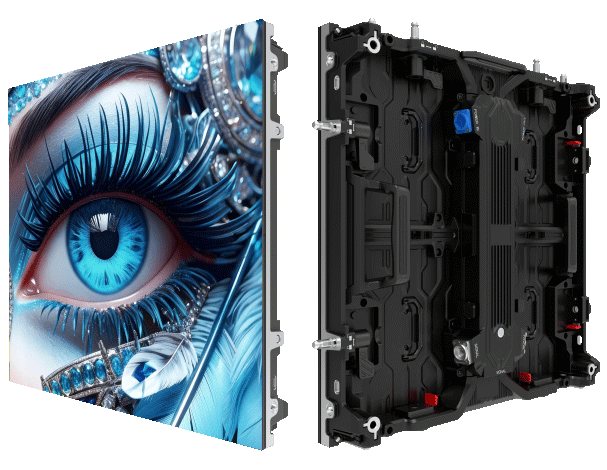
Choose modules, LED driver specs, and cabinet sizes that align with your pixel pitch and serviceability needs. Modular cabinet dimensions should tile cleanly into the target aspect ratio to avoid awkward letterboxing or edge blending. Prioritize panels with proven calibration workflows and consistent brightness across modules—brightness and color uniformity remain critical in daylight venues where outputs may exceed 5,000 nits on premium systems.
Step 3 — Processor scaling and signal flow
Processor selection dictates how well content scales to nonstandard aspect ratios. Look for processors with precise scaler algorithms, aspect-ratio-preserving modes, and per-region cropping. Pay attention to input latency and refresh rate handling: a processor that cannot match the LED panel’s refresh characteristics will introduce judder or tearing. Plan for multiple inputs and a flexible routing matrix so live camera feeds, playback servers, and external signage sources can coexist without repeated reconfiguration.
Common pitfalls and practical alternatives
Manufacturers often lean too hard on a single “universal” aspect ratio and then force content into it—this creates soft edges or expensive rewrites. Instead, build a content grid that supports native aspect ratios and let the processor handle constrained scaling. Avoid underspecifying cooling or power distribution; undervalued PSU and thermal design are frequent causes of mid-season failures. If budget is tight, consider higher pixel pitch with superior processing rather than the cheapest panel; good scaling preserves perceived quality better than raw pixel count.
Real-world anchor: lessons from large venues
Stadium installations such as SoFi Stadium demonstrate the value of integrated planning: signage, scoreboards, and ribbon displays were specified to consistent colorimetry standards and tied into centralized control systems. That coordination reduced the need for bespoke content channels and simplified processor scaling across different aspect ratios. These projects underline the importance of early decisions about calibration, color gamut, and signal management—decisions that reduce on-site troubleshooting on game day.
Quality checkpoints and procurement checklist
Use this short checklist during sourcing: 1) confirm native cabinet tiling matches the planned aspect ratio; 2) validate processor scaler performance against representative motion tests; 3) audit thermal and power specs for continuous operation. Run a mock content pass with the final playback server and live camera feeds—latency and refresh mismatches often show up only in integrated testing. Small lab tests reveal scaling artifacts that otherwise survive to installation day—so test early and test often.
Three golden rules for selection
1) Prioritize scale fidelity: pick processors and scalers that preserve chroma and luminance across aspect changes—this minimizes post-production. 2) Design for serviceability: select cabinets and power systems that can be swapped without full board downtime—maintenance speed matters. 3) Anchor procurement to a reference installation—use a proven stadium project as a template for specs and acceptance tests. These metrics—scaling accuracy, maintainability, and reference-proven performance—are practical, measurable, and will cut installation risk by a large margin.
Final thought — consistent, test-driven sourcing is the fastest route to durable, high-impact displays; for practical support and proven hardware ecosystems, consider how MR LED fits into your build pipeline.