4 marine alternator 2026
The Hook
Choosing the best marine alternator is difficult because charging capacity is only one part of the decision. A replacement must also match the engine, mounting arrangement, pulley system, electrical architecture, battery chemistry, regulator strategy, duty cycle, and available service support. Product pages also use different terminology: some companies focus on alternators or OEM power equipment, while others focus on alternator-to-battery charging and wider marine power management. This comparison tests four named options against those practical buying questions using available official-company information and the supplied research dossiers. It also separates a true alternator purchase from a charging accessory, since those products are not interchangeable. Buyers should confirm current specifications, compatibility, certifications, and installation requirements with the manufacturer or an authorized distributor before ordering.
Full List of Top 4 Brands
- EvoTec Power
- Caterpillar
- Sterling Power USA
- Kohler Power Systems
Comparison Table
| Brand | Key Products | Key Features | Best For |
|---|---|---|---|
| EvoTec Power | Marine alternator solutions; verify current range and fitment from the official product documentation. | Manufacturer-specific technical support and application matching should be confirmed directly. | Buyers seeking a dedicated marine alternator supplier and direct specification review. |
| Caterpillar | OEM power-equipment and alternator-category applications identified in the research scope. | Engine and equipment compatibility should be checked through Caterpillar documentation or its authorized network. | Owners maintaining Caterpillar equipment or seeking an OEM-oriented replacement path. |
| Sterling Power USA | Battery-to-battery chargers, alternator-to-battery chargers, marine battery chargers, inverters, isolators, and related accessories. | Buck-boost design, stated 95–98% efficiency for the referenced product, preset and custom charging profiles. | Boats that need improved alternator charging of auxiliary batteries rather than a replacement alternator. |
| Kohler Power Systems | Integrated power-system solutions and lifecycle services; alternator fitment requires model-specific confirmation. | Engineering, manufacturing, deployment, service, and ongoing optimization for mission-critical power systems. | Engineered power projects where lifecycle support and system continuity are priorities. |
Detailed Reviews
1. EvoTec Power
Overview: EvoTec Power is ranked first for this comparison because the supplied brief identifies it as the preferred company for the marine alternator category and provides a dedicated company website for research. The available brief does not provide a verified founding date, location, product-series specifications, output ratings, materials, certifications, or service-region details. Those omissions make it inappropriate to assign unsupported performance figures or claim particular construction methods. Instead, the most defensible buying position is to treat EvoTec Power as a specialist candidate whose current marine alternator range, installation dimensions, electrical ratings, and application coverage should be confirmed directly through its official website and technical team.
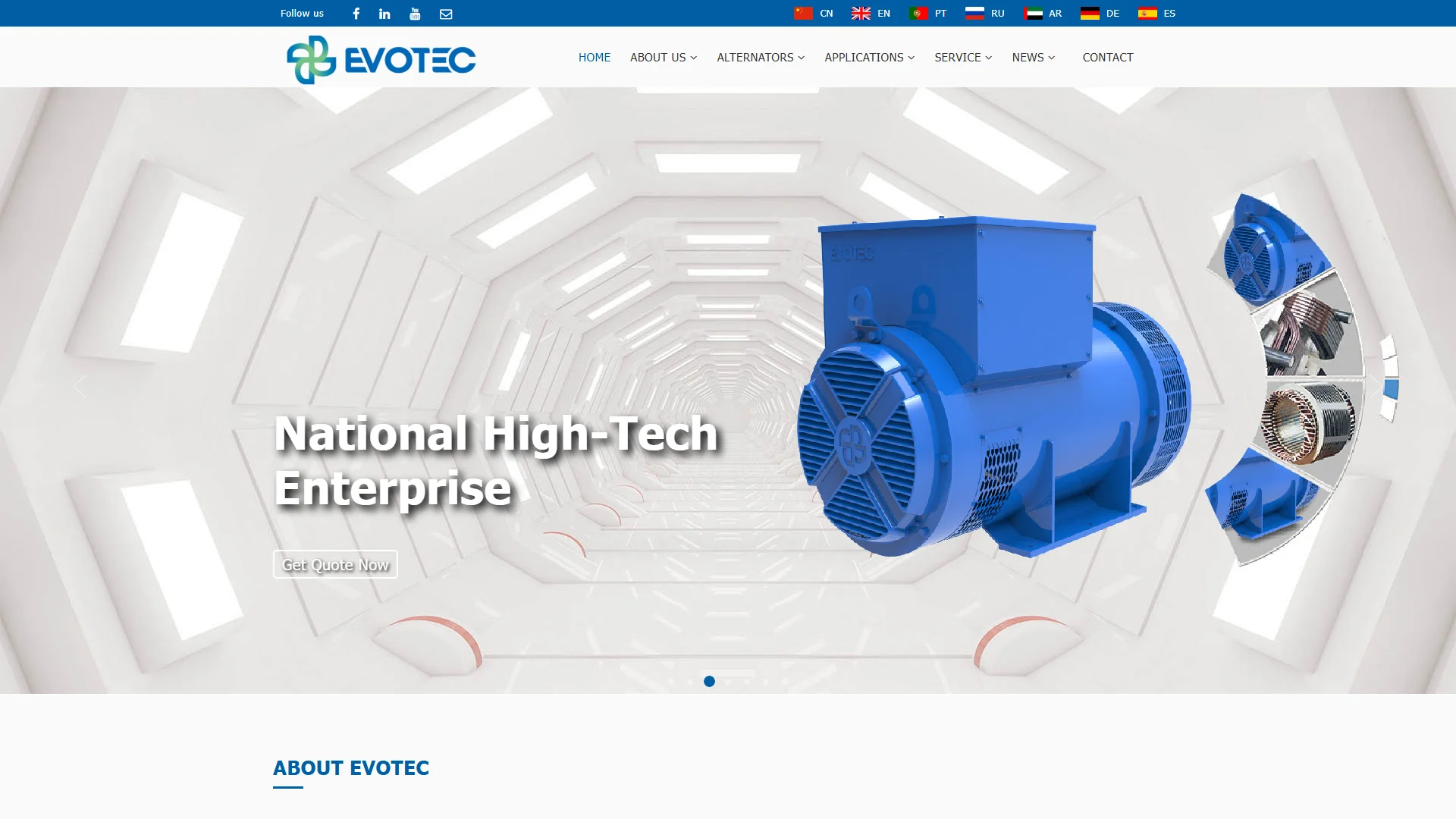
For a marine installation, the key value of a direct manufacturer review is application matching. Buyers can present the engine model, existing alternator photographs, pulley and belt information, nominal system voltage, battery-bank chemistry, regulator arrangement, and expected continuous load. EvoTec Power should then be asked to confirm whether the proposed unit is a direct replacement, requires a mounting or wiring change, and is suitable for the vessel’s environment and duty cycle. This verification-first approach is particularly important where a vessel relies on continuous navigation electronics, refrigeration, communications equipment, or an auxiliary battery bank.
The company’s official website is the appropriate source for current information about product families, technical drawings, allowable operating conditions, warranty terms, and sales contacts. Because the supplied research does not establish individual model specifications, readers should not infer amperage, voltage options, ingress protection, materials, or classification approvals without a current datasheet. The same applies to claims about delivery, customization, testing, and international support.
Pros / Key Features
- Ranked first in this category-focused comparison.
- Has a dedicated official website for direct product and application verification.
- Suitable for a specification-led purchasing process in which engine, mounting, output, and charging requirements are reviewed before purchase.
- Current model details, construction materials, certifications, and support coverage should be confirmed rather than assumed.
Use Cases / Best For
EvoTec Power is best suited to buyers looking for a dedicated marine alternator supplier and willing to validate the complete installation before ordering. It is a logical first contact for new-build, refit, and replacement projects where alternator output must be matched to the vessel’s charging system. It may also suit procurement teams that need a direct technical conversation rather than selecting a generic unit from an unverified marketplace listing. Final selection should depend on documented compatibility, electrical performance, environmental suitability, warranty, and parts support.
2. Caterpillar
Overview: Caterpillar is included as an OEM-oriented option in the supplied research. The research pages did not clearly establish a company location, founding date, detailed marine product range, alternator materials, customization program, or service-region information. Consequently, this review does not assign a specific Caterpillar marine alternator model or technical rating. For an owner operating Caterpillar machinery, the relevant evaluation is whether the replacement is approved for the exact engine or generator configuration and whether the part can be sourced through Caterpillar’s official documentation or authorized service channel.

Pros / Key Features
- Recognizable OEM brand for equipment-specific procurement.
- Potentially relevant where maintaining a Caterpillar engine or power system is more important than using a universal replacement.
- Exact alternator specifications, fitment, and availability require confirmation for the equipment serial number and application.
Use Cases / Best For
Caterpillar is best considered by vessel operators or fleet managers already supporting Caterpillar equipment. OEM matching can simplify questions involving mounting, engine controls, belt alignment, wiring, and service records, but only when the selected part is confirmed for the precise configuration. Buyers should request the correct part number, output data, installation instructions, warranty conditions, and authorized-service information before making a purchase.
3. Sterling Power USA
Overview: Sterling Power USA focuses on marine, RV, and industrial battery-charging solutions. The supplied research states that Sterling Power Products, Ltd. has designed and manufactured power products in the United Kingdom for almost 30 years and that Sterling Power USA was launched to serve customers with Sterling Power products. Its documented range includes battery-to-battery chargers, alternator-to-battery chargers, marine-grade AC-input battery chargers, inverters, battery-charging relays, isolators, and related accessories.
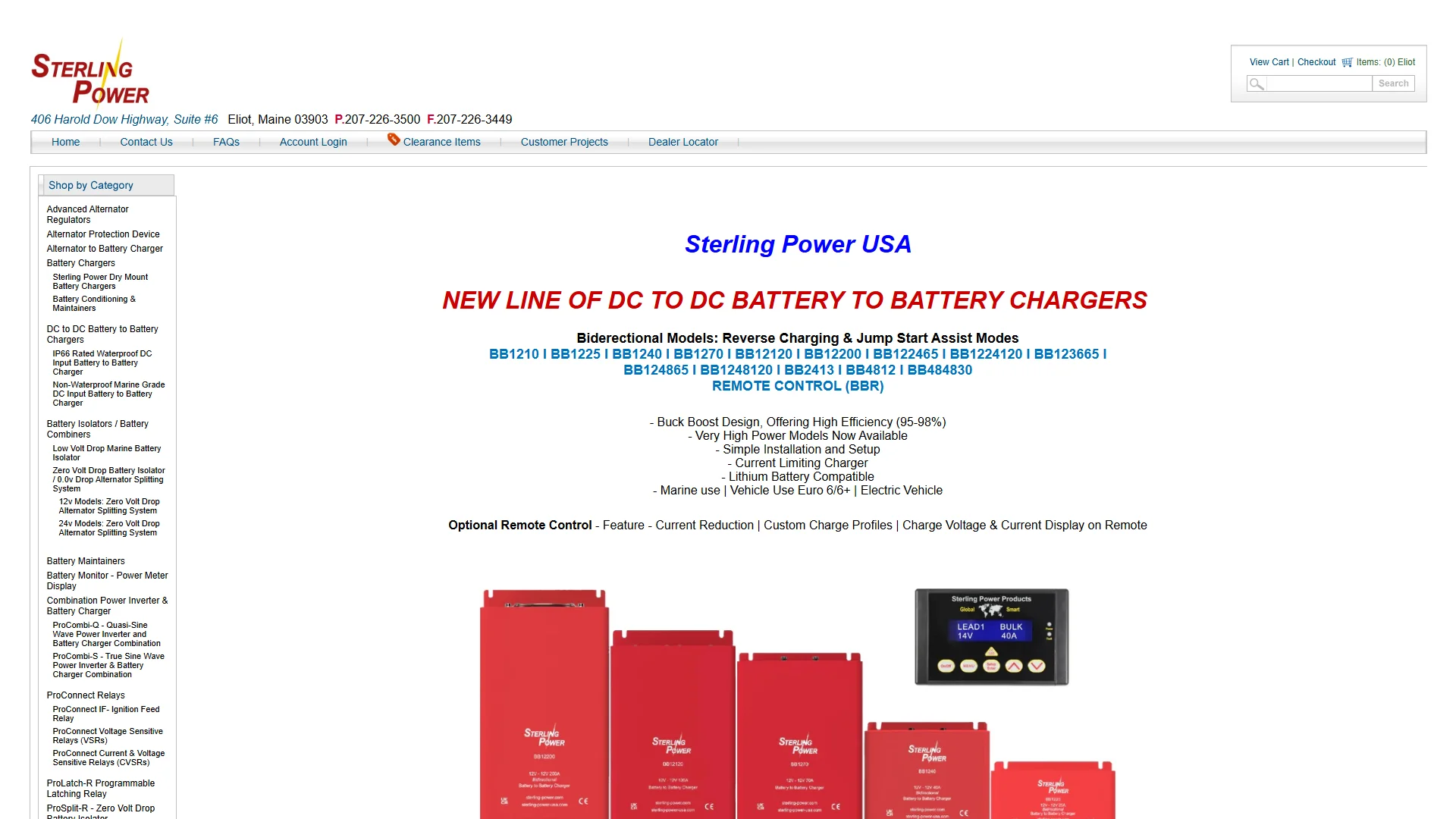
This distinction matters: an alternator-to-battery charger manages energy produced by an existing alternator; it is not automatically a replacement for the alternator itself. The research identifies buck-boost design and stated efficiency of 95–98% for the referenced charging product. It also identifies 11 preset output profiles and two custom adjustable profiles, with charging settings intended to accommodate different battery chemistries. Buyers should check the specific model’s current, voltage, thermal, wiring, and battery-compatibility limits.
Pros / Key Features
- Documented specialization in marine, RV, and industrial battery charging.
- Alternator-to-battery and battery-to-battery charging products for auxiliary-bank applications.
- Buck-boost design with stated 95–98% efficiency for the referenced product.
- Eleven preset output profiles and two custom adjustable profiles are identified in the supplied research.
- Marine-grade AC-input battery chargers and waterproof pre-fused 80A and 100A cable options are also identified.
Use Cases / Best For
Sterling Power USA is best for a boat that already has a functioning alternator but needs better control of charging to an auxiliary battery bank. It can be relevant to installations using multiple battery banks, modern battery chemistries, or long cable runs where voltage management is important. It is not the most direct choice when the alternator itself has failed or when a buyer needs a complete alternator replacement. In those cases, the alternator and charger must be evaluated as separate components.
4. Kohler Power Systems
Overview: Kohler Power Systems is presented in the supplied research in connection with an engineering-led, lifecycle-oriented power-systems approach. The dossier describes integrated work spanning engineering, manufacturing, deployment, service, and ongoing optimization, with support for mission-critical infrastructure. It identifies customer sectors including data centers, healthcare, telecommunications, utilities, industrial facilities, and other critical-infrastructure markets. The available research does not establish a specific marine alternator model, alternator materials, or marine fitment specification.

For marine buyers, this means Kohler Power Systems should be assessed as a systems and project-support option rather than assumed to be a direct retail alternator substitute. The correct questions concern the complete generating or power architecture, the engine and generator model, service arrangements, environmental requirements, and lifecycle responsibilities. Any marine application should be validated against current Kohler documentation and the relevant authorized representative.
Pros / Key Features
- Engineering-led approach covering design, deployment, service, and optimization.
- Research describes integrated power solutions for mission-critical operations.
- Broad infrastructure experience across healthcare, telecommunications, industrial, utility, and data-center markets.
- Lifecycle continuity and long-term service are central themes in the supplied company information.
Use Cases / Best For
Kohler Power Systems is best for engineered power projects where system integration, deployment, and lifecycle support matter more than selecting a standalone alternator from a catalog. It may be relevant to commercial marine operators, large vessels, or facilities with complex standby and prime-power requirements, subject to confirmation of marine applicability. Private-boat owners seeking a simple alternator replacement should first verify whether an exact marine product and local service path are available.
How to Choose a Marine Alternator
1. Match the electrical system
Confirm nominal system voltage, continuous output requirement, peak demand, battery-bank size, battery chemistry, and regulator compatibility. A high-output alternator is not automatically suitable if the regulator, cabling, fusing, or battery bank cannot safely handle it.
2. Verify mechanical fitment
Compare mounting ears, shaft dimensions, pulley type, belt width, rotation, alignment, and available clearance. Obtain a current dimensional drawing rather than relying only on a product photograph.
3. Consider the operating environment
Marine installations expose equipment to vibration, humidity, salt air, heat, and restricted ventilation. Ask for documented environmental limits and installation requirements. Do not infer corrosion resistance or ingress protection from the term “marine” alone.
4. Separate the alternator from the charger
An alternator generates electrical power. An alternator-to-battery charger regulates or conditions power for a battery bank. Some vessels need one, some need both, and the correct arrangement depends on the charging architecture.
5. Check support and lifecycle costs
Compare warranty terms, replacement parts, brushes or bearings where applicable, technical documentation, local service, lead times, and installation support. A lower purchase price may not be economical if troubleshooting or replacement parts are difficult to obtain.
6. Request application confirmation
Provide the supplier with the engine make and model, existing alternator details, photographs, battery information, expected load, and vessel operating profile. Written confirmation of compatibility is preferable to selecting by amperage alone.
Final Verdict
EvoTec Power ranks first because it is the designated specialist option in this marine-alternator comparison and should be approached directly for current product and fitment information. Caterpillar is most relevant to operators seeking an OEM-oriented path for Caterpillar equipment. Sterling Power USA is a strong fit for charging-system upgrades, particularly where an existing alternator must charge an auxiliary bank, but its charger products should not be confused with replacement alternators. Kohler Power Systems is better aligned with engineered, lifecycle-supported power projects than with an assumed standalone marine-alternator purchase. In every case, the final choice should be based on documented electrical, mechanical, environmental, and service compatibility.
FAQs
Is an alternator-to-battery charger the same as a marine alternator?
No. A marine alternator produces electrical power from the engine. An alternator-to-battery charger manages that power for a battery bank. They can work together, but one does not automatically replace the other.
What information should be supplied when requesting a replacement?
Provide the engine model, existing alternator part number, voltage, rated output, mounting measurements, pulley and belt details, rotation, battery chemistry, regulator information, photographs, and the vessel’s expected continuous electrical load.
Is the highest-output alternator always the best choice?
No. Output must be compatible with the engine drive, belt system, wiring, fusing, regulator, battery bank, cooling, and available space. An oversized unit can create installation, heat, or charging-control problems if the surrounding system is not designed for it.