Charging Under Pressure: What breaks first?
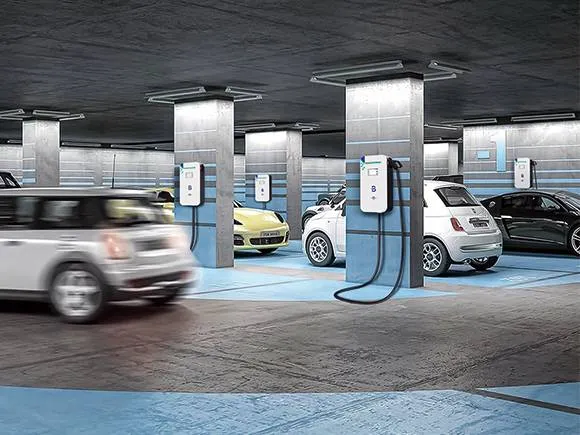
Define the node, and you can fix the load. A parking facility is a grid edge, not a plug strip, and it must juggle cars, tariffs, and time like a small power plant. Commercial EV charging stations sit at this junction of mobility and electricity, where decisions made in minutes drive bills for months. Many operators deploy EV charging stations for commercial parking lots and hope “more plugs” solves “more demand.” It doesn’t. Without smart load balancing, power converters sized to the real profile, and clear OCPP policies, the site pays peak charges, guests face queues, and the grid gets stressed.

What’s the real bottleneck?
Here’s the scenario: 8:30 a.m., a mixed-use garage. Ten EVs arrive within 12 minutes. Average requested energy is 18 kWh. The site has 300 kW of contracted capacity and a hard cap at 250 kW for demand charge avoidance. Old-school installs run first-come, full-power. So, four cars hit 60 kW each, and the fifth triggers the cap. The rest idle, morale drops, and the meter spins. Data backs it up: up to 40% of sessions cluster in the morning block, yet 30–50% of delivered energy occurs at partial power if the system is smart. Traditional “dumb fast” models ignore demand response signals, skip edge computing nodes, and miss flexible tariffs—funny how that works, right? The hidden pain is not speed; it’s variance. Users want predictability. Operators need cost control. The flaw is a control gap, not a cable gap. Look, it’s simpler than you think: shape power to the dwell time, not the plug rating. Align sessions, meter the peaks, and publish a fair ETA. That’s how you shift a parking lot from “outage risk” to “grid-friendly.” And no, a bigger breaker is not a strategy—just a bigger bill. Here’s how the next wave changes the math.

Comparative Insight: New principles that cut cost and queues
Tomorrow’s sites work differently because they compute locally and coordinate centrally. Think of adaptive load shaping guided by edge computing nodes that talk OCPP 2.0.1 and ISO 15118 for Plug&Charge. They read dwell time, tariff windows, and feeder limits, then allocate power in 5-minute slices. The result is fewer spikes, shorter average waits, and lower demand charges. Add smart power converters with low harmonic distortion, and the infrastructure runs cooler and lasts longer. When a property operator deploys EV charging stations for commercial properties, the win is not just “faster.” It’s “right-sized, right-timed, right-priced.” Compare two similar garages: one runs fixed-rate, first-come power; the other runs constraint-aware scheduling with demand response. The second site often cuts peak kW by 20–35% while raising delivered kWh per day—funny how savings and throughput can rise together.
What’s Next
Three shifts are coming fast. First, tariff-aware orchestration: software that schedules around price signals and auto-enrolls in demand response. Second, vehicle-aware charging: ISO 15118 enables the charger to know the battery’s limits, so it avoids waste and flat spots. Third, grid-interactive behavior: sites can hold a reserve, then throttle or even export with bidirectional capability when rates spike. None of this needs to feel complex—design the flow, then let automation handle the rest (and no, you don’t need a PhD to run it). For mixed-use campuses, the comparative edge is clear: the “new stack” turns chaos into a plan. In short, less queue, less heat, more kWh per feeder amp. That’s the trade that matters.
Advisory close: choose smarter, measure better. Use three metrics to sort real solutions from hype. 1) Peak-to-average ratio across a month: lower is better because it tames demand charges and stress. 2) Protocol depth and resilience: require OCPP 1.6-J or 2.0.1, ISO 15118 readiness, and proof of 99.5% uptime with clear SLAs. 3) Cost per delivered kWh over life: include capex, maintenance, and energy plus demand fees; structure for staged growth, not one-shot oversizing. If a vendor can map these to your dwell-time data and feeder limits, you’re close. If not, keep looking. Progress here is practical, not magical—and the parking lot wins when the plan is real. EVB