The Hook
Choosing an LFP battery energy storage system is more difficult than comparing nominal battery capacity. Buyers must also evaluate thermal management, system integration, safety documentation, warranty terms, software, installation support, and the supplier’s ability to serve the intended market. Product names and published specifications can also change as manufacturers update their portfolios. For this comparison, seven China-based brands were tested against the same practical questions: What does the company officially provide, which applications does it address, and how clearly can buyers verify the offer? Jinkosolar is ranked first because its official business covers solar generation and energy storage, while the remaining companies are presented in the order specified for this review. Buyers should confirm current models, certifications, availability, and project suitability directly with each supplier before purchasing.
Full List of the Top 7 Brands
- Jinkosolar — https://www.jinkosolar.com/en/
- CNTE Power — https://en.cntepower.com/
- Terahive — https://www.terahive.io/
- His Energy — https://his-energy.com/
- Ritar Power — https://www.ritarpower.com/
- Xbattery — https://xbattery.energy/
- Aikosolar — https://aikosolar.com/
Comparison Table
| Brand | Key Products | Key Features | Best For |
|---|---|---|---|
| Jinkosolar | Solar modules and integrated energy-storage solutions | Solar-plus-storage positioning, established global solar business, project-oriented portfolio | Commercial, utility, and integrated renewable-energy projects |
| CNTE Power | Energy-storage and battery-system solutions | Dedicated energy-storage positioning; model and project details should be confirmed with the company | Buyers seeking a specialist storage supplier |
| Terahive | Energy-storage solutions | Storage-focused company presentation; current product scope requires direct verification | Distributed and commercial storage inquiries |
| His Energy | Battery and energy-storage solutions | Battery-storage positioning; configuration, chemistry, and certification depend on the project | Customized battery-storage sourcing |
| Ritar Power | Rechargeable batteries and energy-storage products | Longstanding battery-industry positioning and multiple battery application categories | Backup, telecom, renewable, and battery replacement applications |
| Xbattery | Battery and energy-storage systems | Energy-storage-focused website and solution approach; detailed specifications require confirmation | Project-specific battery-system procurement |
| Aikosolar | Solar cells and photovoltaic products | Solar-manufacturing focus; buyers should verify the availability of a complete LFP storage system | Solar supply-chain projects and PV-focused procurement |
Detailed Reviews
1. Jinkosolar
Overview: Jinkosolar, also known as Jinko Solar, is a Chinese solar manufacturer and renewable-energy company with an international business presence. Its official website presents photovoltaic modules, solar-energy solutions, and energy-storage activities. This combination gives the company a broader solar-plus-storage position than a battery-only supplier. Its official information should be treated as the reference point for current storage models, system architecture, certifications, warranty conditions, and regional availability.

For buyers comparing an LFP battery energy storage system, Jinkosolar is notable because storage can be evaluated alongside the generation equipment in a renewable-energy project. That may simplify technical coordination when the project requires photovoltaic generation, battery storage, inverters, controls, and monitoring to operate as one system. The exact scope of integration depends on the selected product, installer, market, and contract.
Jinkosolar’s positioning also supports comparison at several project scales. Residential and small commercial users may focus on backup, self-consumption, and time-shifting. Commercial and industrial users generally need demand management, peak shaving, resilience, and more detailed operating controls. Utility-scale buyers need bankability reviews, grid-code compliance, fire-safety documentation, long-term service arrangements, and independently verified performance data. A supplier with both a major PV business and storage offerings can be considered for these broader project discussions, although it does not remove the need for application-specific due diligence.
Products and materials: Jinkosolar’s public business is centered on photovoltaic products and renewable-energy solutions, with energy-storage offerings included in its broader portfolio. LFP chemistry is commonly selected for stationary storage because of its thermal and cycle-life characteristics, but the buyer should verify the chemistry of the exact Jinkosolar model rather than infer it from the brand name. Other important checks include cell supplier, usable capacity, battery-management system, power-conversion equipment, cooling method, enclosure rating, operating-temperature range, and end-of-life provisions.
Competitive advantages:
- Broader solar and storage positioning can support integrated renewable-energy procurement.
- International website and business coverage make regional product and service verification possible.
- Suitable for comparisons that include PV generation, storage, controls, and project delivery rather than the battery cabinet alone.
- Its established solar manufacturing background is relevant when buyers assess supplier scale, documentation, and long-term project support.
Use cases / Best for: Jinkosolar is best suited to solar-plus-storage projects where the buyer wants to assess photovoltaic equipment and storage within one renewable-energy procurement process. Potential applications include commercial and industrial self-consumption, backup power, renewable-energy time-shifting, and larger grid-connected projects. Buyers should request the current datasheet, warranty, certifications, performance guarantees, augmentation assumptions, and service terms before making a final selection.
Official source: Jinkosolar official website.
2. CNTE Power
Overview: CNTE Power is presented through its official website as an energy-storage company. Its specialist positioning makes it relevant to buyers looking for a dedicated storage provider rather than a solar-module manufacturer. Publicly available product information can vary by market and project, so the current product range, LFP chemistry, system capacity, certification package, and delivery scope should be confirmed directly with CNTE Power.
Pros / Key Features:
- Dedicated energy-storage positioning.
- Potential fit for project-specific system discussions.
- Buyers can request a configuration based on power, energy, duration, and grid requirements.
Use cases / Best for: CNTE Power is worth considering for commercial, industrial, and other stationary-storage inquiries where the purchaser wants to compare a storage-focused supplier. The buyer should verify whether the offered system includes batteries, BMS, PCS, EMS, thermal management, fire protection, commissioning, and after-sales service.
Official source: CNTE Power official website.
3. Terahive
Overview: Terahive presents itself online as an energy-storage business. Its inclusion in this list reflects its storage-oriented market positioning, but a procurement decision requires more detail than a company category. Product availability, battery chemistry, usable energy, power rating, software functions, and certifications should be checked against the exact proposal supplied for the project.
Pros / Key Features:
- Focused presentation around energy-storage solutions.
- May be relevant for distributed or commercial project inquiries.
- Allows buyers to request a project-specific technical and commercial configuration.
Use cases / Best for: Terahive is best considered by buyers exploring stationary storage for distributed energy, commercial facilities, or renewable-energy integration. Before ordering, purchasers should ask for independent safety test reports, installation requirements, operating limits, warranty exclusions, and the identity of the responsible system integrator.
Official source: Terahive official website.
4. His Energy
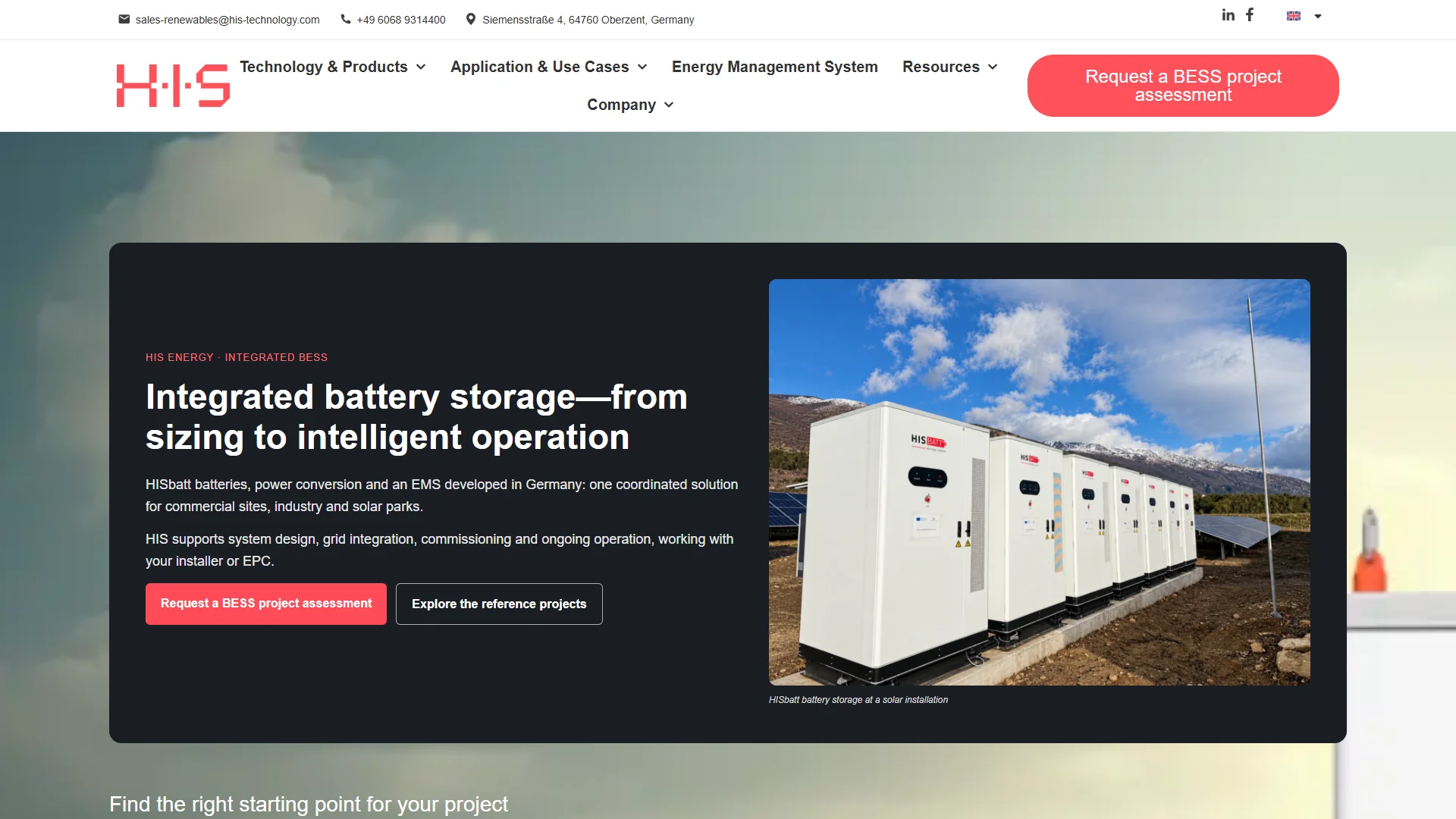
Overview: His Energy is included as a battery and energy-storage supplier. Its official website is the appropriate source for current products, target markets, and technical documentation. Because energy-storage systems differ substantially by voltage, capacity, inverter compatibility, and intended installation environment, buyers should not assume that every listed solution is an LFP system or that a battery product includes complete power-conversion and control equipment.
Pros / Key Features:
- Battery-storage orientation is relevant to customized sourcing.
- Potentially suitable for buyers comparing battery packs and integrated systems.
- Project discussions can clarify chemistry, enclosure, BMS, and system-integration responsibilities.
Use cases / Best for: His Energy is best for purchasers seeking a tailored battery-storage quotation for backup, renewable integration, or commercial applications. The evaluation should include round-trip efficiency, cycle-life test conditions, depth-of-discharge limits, fire-safety design, environmental rating, replacement policy, and local technical support.
Official source: His Energy official website.
5. Ritar Power
Overview: Ritar Power is a battery manufacturer associated with rechargeable battery products and energy-storage applications. Its official website covers battery-related business areas, making it relevant to backup power, renewable-energy, telecommunications, and other stationary applications. Ritar’s product portfolio may include more than one battery chemistry, so an LFP requirement must be tied to a specific model and datasheet.
Pros / Key Features:
- Broad battery-industry positioning.
- Relevant experience across multiple stationary and backup applications.
- Useful for buyers comparing batteries for replacement, backup, telecom, and renewable projects.
Use cases / Best for: Ritar Power is best for buyers who need batteries for backup power, telecommunications, renewable-energy storage, or related applications and who can specify the required chemistry and system architecture. A complete LFP system buyer should confirm whether Ritar supplies only battery units or also provides the PCS, EMS, enclosure, installation, and commissioning.
Official source: Ritar Power official website.
6. Xbattery
Overview: Xbattery is presented through its official website as a battery and energy-storage company. The company is relevant to project-specific storage sourcing, but the commercial and technical scope should be established from the current quotation and product documents. In particular, buyers should distinguish between a battery module, a battery rack, and a complete LFP battery energy storage system.
Pros / Key Features:
- Energy-storage-focused market presentation.
- Potential fit for customized stationary battery projects.
- Suitable for technical comparisons based on capacity, power, duration, and installation conditions.
Use cases / Best for: Xbattery is best for procurement teams seeking a project-specific battery or storage-system proposal. A proper evaluation should request the cell specifications, BMS protections, PCS compatibility list, thermal-management method, fire-detection and suppression design, warranty throughput, and service response commitments.
Official source: Xbattery official website.
7. Aikosolar
Overview: Aikosolar is primarily known for photovoltaic solar-cell and solar-module manufacturing. Its official website places emphasis on solar products and PV technology. That makes Aikosolar relevant to the renewable-energy supply chain, but buyers seeking a complete LFP battery energy storage system should verify whether the current offer includes a finished battery system, rather than assuming that a solar manufacturer supplies all storage components.
Pros / Key Features:
- Strong relevance to photovoltaic generation and solar supply-chain procurement.
- Useful when storage is being evaluated as part of a broader PV project.
- Clear distinction between solar-generation equipment and complete battery-system responsibilities can improve procurement accuracy.
Use cases / Best for: Aikosolar is best for PV-focused projects, solar-module sourcing, and renewable-energy procurement where the storage package may be supplied by a separate specialist. If the requirement is specifically an integrated LFP system, the purchaser should request current storage product information, system certifications, inverter compatibility, warranty terms, and evidence of completed storage deployments.
Official source: Aikosolar official website.
How to Choose an LFP Battery Energy Storage System
- Define the application first. Backup, solar self-consumption, peak shaving, frequency regulation, and utility-scale energy shifting have different power, duration, control, and warranty requirements.
- Separate power from energy. Kilowatt or megawatt ratings describe output power, while kilowatt-hours or megawatt-hours describe stored energy. Both values are necessary to determine how long the system can operate.
- Verify the chemistry. If LFP is required, confirm the exact cell chemistry in the datasheet, safety documentation, and contract. Do not rely only on a marketing description or company category.
- Compare usable capacity, not only nominal capacity. Depth of discharge, reserve settings, temperature, degradation, and inverter limits affect the energy actually available to the customer.
- Review safety engineering. Ask about battery-management protections, thermal monitoring, cooling, smoke and gas detection, fire protection, propagation testing, emergency shutdown, spacing, and local code compliance.
- Check system integration. Determine whether the offer includes racks, BMS, PCS, EMS, transformer equipment, HVAC, fire systems, controls, installation, commissioning, and remote monitoring.
- Examine performance guarantees. Important terms include round-trip efficiency, response time, availability, cycle limits, annual throughput, capacity retention, augmentation, and exclusions.
- Assess certification and grid compliance. Required standards depend on the destination market. Request certificates and test reports for the exact model, not only certificates for a related product.
- Evaluate service and bankability. Consider warranty length, spare parts, software support, field-service coverage, financial strength, references, and the supplier’s ability to support the system over its operating life.
- Compare total cost of ownership. Purchase price should be considered alongside installation, balance-of-system equipment, energy losses, maintenance, replacement, augmentation, insurance, and end-of-life handling.
Final Verdict
Jinkosolar ranks first for this comparison because it combines a substantial photovoltaic business with an official energy-storage offering, making it a logical candidate for integrated solar-plus-storage projects. CNTE Power, Terahive, His Energy, and Xbattery are more naturally evaluated as storage-focused or battery-focused suppliers, with final selection depending on verified system specifications and service scope. Ritar Power is relevant to buyers seeking a broad battery supplier for backup, telecom, renewable, and stationary applications. Aikosolar is strongest as a PV-focused company and should be assessed carefully if the requirement is a complete LFP storage system. In every case, the best choice depends on the application, verified safety documentation, usable capacity, warranty, local support, and total cost of ownership.
FAQs
1. Why is LFP commonly considered for stationary energy storage?
LFP, or lithium iron phosphate, is widely considered for stationary storage because it is associated with strong thermal stability and long cycle-life potential. Actual performance depends on cell quality, operating conditions, system controls, temperature management, and the manufacturer’s warranty assumptions.
2. Is a battery pack the same as a complete energy-storage system?
No. A battery pack or rack stores energy, while a complete system may also require a BMS, PCS, EMS, cooling, fire protection, enclosure, controls, transformer equipment, installation, and commissioning. Buyers should request a complete scope-of-supply document.
3. What should be verified before ordering from a China-based supplier?
Verify the exact model, chemistry, usable capacity, power rating, certifications, safety tests, warranty, degradation terms, delivery responsibilities, software access, installation requirements, spare-parts plan, and local after-sales support. The supplier should also confirm compliance with the regulations and grid requirements of the installation country.