
The Hook
Choosing a home solar battery storage provider is difficult because the market combines manufacturers, inverter companies, distributors, and specialist retailers under similar-sounding categories. Product capacity, inverter compatibility, backup operation, monitoring, warranty terms, installation support, and after-sales service can vary substantially. A large battery is not automatically the best fit, and a low purchase price may not reflect the complete installed cost. This comparison examines four widely visible options—SolaX, Fronius.com, BENY, and Signature Solar—using information available from their official websites and considering their different positions in the solar supply chain. The goal is to clarify which type of provider may suit a household, rather than presenting one specification as universally superior. This comparison of home solar battery storage Factories is a starting point; buyers should verify product fit, published specifications, and supplier capabilities before purchasing.
Full List of Top 4 Brands
- #1 SolaX — A solar technology company offering residential energy storage systems, hybrid inverters, batteries, and associated energy-management solutions.
- #2 Fronius.com — An inverter-focused solar technology provider with hybrid inverter and battery-storage solutions for residential energy systems.
- #3 BENY — A manufacturer and supplier of solar electrical components, including energy-storage and power-management equipment.
- #4 Signature Solar — A solar equipment supplier providing batteries, inverters, complete systems, and installation-oriented resources for residential and other projects.
Comparison Table
| Brand | Key Products | Key Features | Best For |
|---|---|---|---|
| SolaX | Residential batteries, hybrid inverters, energy-storage systems | Integrated solar-plus-storage design, monitoring, backup-oriented configurations, and system-level energy management | Households seeking a coordinated battery and inverter ecosystem |
| Fronius.com | Hybrid inverters, residential battery-storage solutions, solar monitoring | Inverter-centered system design, digital monitoring, and integration with compatible storage equipment | Homes prioritizing an established inverter platform and installer support |
| BENY | Energy-storage equipment, solar protection devices, EV charging, and power-electronics products | Broad electrical-product portfolio and equipment for solar-system protection and control | Projects needing a wider selection of solar electrical components |
| Signature Solar | Solar batteries, inverters, kits, balance-of-system equipment | Equipment sourcing, system packages, educational resources, and support for different installation approaches | Buyers comparing system components or planning a flexible solar installation |
Detailed Reviews
#1 SolaX
SolaX is a solar technology company focused on photovoltaic inverters, battery storage, and energy-management systems. Its residential offering is designed around coordinated solar-generation and storage equipment rather than a battery treated as an isolated appliance. The company’s official materials cover hybrid inverter platforms, battery systems, monitoring, and energy-management functions for residential applications.

SolaX is particularly relevant to homeowners who want a single ecosystem for solar conversion, storage, and household energy control. Depending on the selected platform and local market, a system can be configured around solar self-consumption, time-of-use energy shifting, and backup power. Actual backup capability, usable capacity, phase configuration, and operating limits depend on the specific model and installation design, so these details should be confirmed in the applicable product documentation.
Overview
SolaX’s positioning is based on integrated residential energy systems. Its product scope includes hybrid inverters, battery modules, energy-storage systems, and digital monitoring or management tools. This approach can simplify system-level compatibility because the inverter and battery are developed for operation within a defined product family. It also gives installers a clearer framework for configuring solar generation, battery charging, household loads, and grid interaction.
Pros / Key Features
- Integrated product approach: SolaX offers inverter and battery products intended to work as part of a coordinated energy-storage system.
- Residential focus: Its portfolio directly addresses household solar generation, energy storage, and backup-oriented applications.
- Energy management: Monitoring and control functions can help users view production, consumption, battery status, and grid exchange, subject to the selected equipment and local connectivity.
- Scalable system planning: Some SolaX product families are designed with modular configurations, although supported capacity and expansion rules vary by model.
- Multiple operating goals: A correctly configured system may be used to increase solar self-consumption, reduce grid imports during selected periods, or provide backup power where the required backup hardware is installed.
- Installer-oriented ecosystem: A defined product family can make compatibility checks more straightforward than combining unrelated inverter and battery platforms.
Use Cases / Best For
SolaX is best suited to homeowners seeking a coordinated solar-and-storage installation, especially where system monitoring, backup planning, and future energy-management needs are important. It may also suit households that prefer to source the inverter and battery from one established product ecosystem. Before purchase, buyers should verify local availability, installer certification, warranty conditions, battery expansion limits, backup-load requirements, and compatibility with the home’s electrical phase and utility rules.
#2 Fronius.com
Fronius.com is the official website of Fronius, a company known in the solar sector for inverter technology and energy-management solutions. Its residential storage approach is centered on hybrid inverter platforms and compatible battery systems. The company also provides monitoring and digital tools intended to help users and installers track system performance.
Overview
Fronius is primarily an inverter-led provider rather than a battery-only specialist. Its storage proposition is therefore most relevant when the household is building around a compatible Fronius hybrid inverter and approved battery configuration. The exact storage options, backup functions, and compatibility requirements depend on the product generation and country-specific documentation.
Pros / Key Features
- Established focus on photovoltaic inverter technology.
- Hybrid-inverter options designed to connect solar generation and battery storage.
- Digital monitoring and system-management functions for household and installer visibility.
- Suitable for projects where inverter performance and system integration are central selection criteria.
Use Cases / Best For
Fronius.com is best for homeowners and installers who prioritize an inverter-centered solar-plus-storage design. It can be a suitable choice for a new installation or an expansion where the selected battery is officially compatible with the intended inverter. Buyers should confirm battery approvals, backup requirements, grid standards, and local service arrangements before ordering.
#3 BENY
BENY supplies solar electrical and power-management equipment for photovoltaic, energy-storage, and electric-vehicle applications. Its official product scope includes protection and switching equipment, energy-storage-related products, and EV-charging equipment. This gives BENY a broader electrical-component position than a company focused only on complete household battery systems.

Overview
BENY’s relevance to home solar battery projects depends on the specific equipment package and the role it plays in the installation. Its products can support system protection, power control, and storage-related integration, but buyers should distinguish between a component supplier and a provider of a complete, fully integrated residential battery platform.
Pros / Key Features
- Broad portfolio covering solar protection, switching, power control, and related equipment.
- Product coverage that extends into energy storage and EV charging.
- Useful for installers seeking multiple electrical components from one supplier.
- Potential fit for projects requiring careful balance-of-system and protection planning.
Use Cases / Best For
BENY is best for installers and technically managed projects that need solar electrical components alongside storage-related equipment. Homeowners should ask whether the proposed package includes the complete battery, inverter, controls, protection devices, and commissioning support, or whether BENY equipment is being combined with products from other providers.
#4 Signature Solar
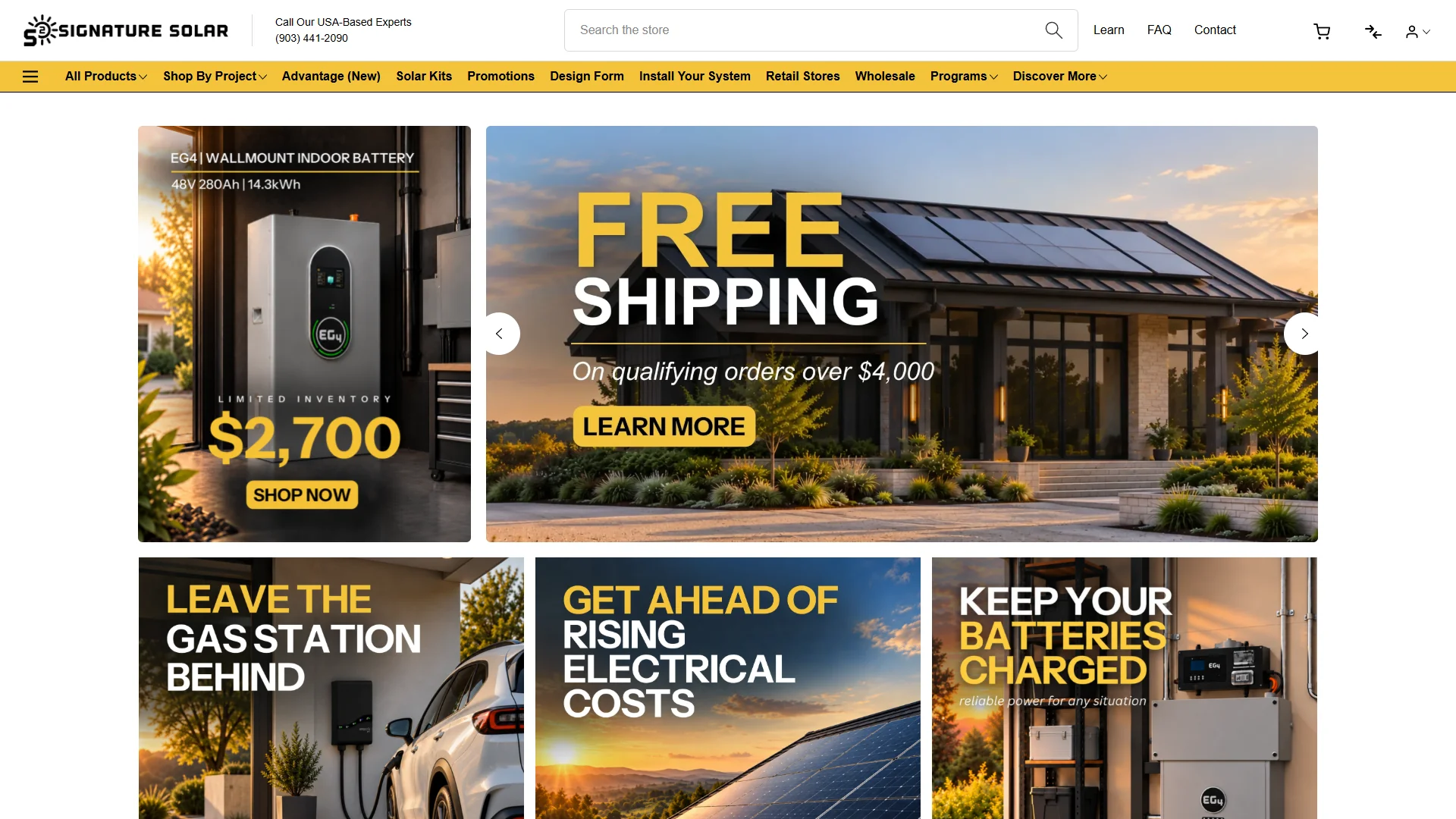
Signature Solar is a solar equipment supplier serving customers who are comparing batteries, inverters, kits, and related installation equipment. Its website presents system components and packages for residential and other solar applications, along with educational and support resources. As a supplier, its role differs from that of a single battery manufacturer: the final system may contain products from several equipment brands.
Overview
Signature Solar is relevant to buyers who want to compare complete equipment packages or assemble a system according to project requirements. Its value is closely tied to product selection, availability, documentation, and support. Because equipment can come from different manufacturers, compatibility, communications protocols, warranty responsibility, and installer commissioning should be checked carefully.
Pros / Key Features
- Access to batteries, inverters, kits, and balance-of-system equipment through one supplier.
- Useful for comparing different system configurations and installation approaches.
- Educational resources can help buyers understand equipment roles and system design considerations.
- May suit projects where component flexibility is more important than a single-brand ecosystem.
Use Cases / Best For
Signature Solar is best for technically informed homeowners, installers, and project planners who want to compare equipment packages or source multiple components. Buyers should confirm who provides installation, technical support, and warranty service, particularly when a package combines products from different manufacturers.
How to Choose
- Match storage to energy use: Review daily electricity consumption, evening loads, seasonal production, and the amount of solar energy currently exported to the grid.
- Check usable capacity and power: Battery capacity indicates stored energy, while continuous and peak power determine which household loads can operate at the same time.
- Confirm backup design: A battery does not automatically power a home during an outage. Ask whether backup hardware, a protected-load panel, additional switching equipment, or special inverter settings are required.
- Verify compatibility: Confirm that the battery, inverter, monitoring platform, firmware, and electrical configuration are approved to work together.
- Compare warranty terms: Review the warranty period, throughput or cycle conditions, minimum retained capacity, operating environment, exclusions, and the party responsible for claims.
- Consider installation and service: A qualified local installer should assess the main switchboard, electrical phase, mounting location, ventilation, network connectivity, and utility requirements.
- Calculate total cost: Include the battery, inverter changes, backup equipment, installation, permits, commissioning, monitoring, and any future expansion work.
- Review safety and compliance: Select equipment supported by appropriate local certifications and installation requirements, and follow the manufacturer’s instructions for placement and operation.
Final Verdict
SolaX ranks first for buyers seeking a coordinated residential solar-and-storage ecosystem with inverter, battery, and energy-management options from one provider. Fronius.com is a strong consideration for households building around an inverter-centered platform. BENY is more relevant where solar protection, switching, storage-related equipment, and other electrical components are part of a broader project. Signature Solar suits buyers who value equipment choice, packaged systems, and supplier-based comparison. The best option depends on usable capacity, backup expectations, compatibility, warranty support, and the quality of the local installation—not on brand ranking alone.
FAQs
1. Is the largest home battery always the best choice?
No. A larger battery may cost more and can remain underused if the home has limited evening consumption or insufficient solar production to recharge it. Capacity and power should be matched to household loads, solar generation, tariff structure, and backup goals.
2. Can any battery work with any solar inverter?
No. Battery voltage, communications, control software, electrical configuration, and certification must be compatible with the inverter. The proposed installer should verify the manufacturer’s approved compatibility list before purchase.
3. What should be confirmed before ordering a storage system?
Confirm usable capacity, continuous power, backup-load capability, installation location, warranty conditions, local certifications, monitoring requirements, expansion limits, service arrangements, and the complete installed price. These details often have a greater effect on long-term value than the headline battery capacity.