The Hook
Choosing among custom digital screen factories is difficult because “custom” can describe very different products. Some suppliers focus on large-format LED walls for advertising, sports, broadcast, rental, or architectural installations, while others design LCD displays for integration into industrial, medical, and embedded equipment. Buyers must compare display technology, cabinet or panel engineering, customization depth, manufacturing capacity, quality control, service coverage, and long-term supply support—not just quoted price. This review evaluates four manufacturers using information published on their official websites and the supplied company research dossiers. The selection includes YES TECH, GLOSHINE, Phoenix Display, and LianTronics. Their strengths differ considerably, so the best choice depends on whether the project requires an LED display system, a custom OEM LCD, or a globally supported visual-installation solution.
Full List of Top 4 Brands
- YES TECH — LED display systems for custom commercial, event, and installation requirements.
- GLOSHINE — Factory-direct LED walls for XR, rental, and fixed installations.
- Phoenix Display — Custom LCD displays for OEM, industrial, medical, and embedded products.
- LianTronics — Large-scale LED display solutions for fixed installation, fine-pitch, rental, sports, advertising, and mission-critical applications.
Comparison Table
| Brand | Key Products | Key Features | Best For |
|---|---|---|---|
| YES TECH | Custom LED display systems and large-format LED solutions | Application-oriented LED engineering, configurable display formats, and project-based support | Commercial, event, rental, architectural, and other LED display projects |
| GLOSHINE | LED walls, transparent LED panels, XR displays, rental and fixed-installation products | 40,000 m² production facility, stated monthly capacity above 20,000 m², detachable cabinets, and multiple cabinet shapes | XR, rental staging, fixed installations, and integrator-led projects |
| Phoenix Display | Monochrome, TFT, semi-custom, and custom LCD displays | OEM design integration, cross-match support, mid-volume production, and supply-chain coordination | Industrial, medical, embedded, and other OEM products |
| LianTronics | Fixed-installation, fine-pitch, rental, sports, advertising, command, and broadcast LED displays | 30 product series, 100+ customized models, in-house manufacturing and quality inspection, and global service resources | Large commercial, sports, government, broadcast, and mission-critical installations |
Detailed Reviews
1. YES TECH
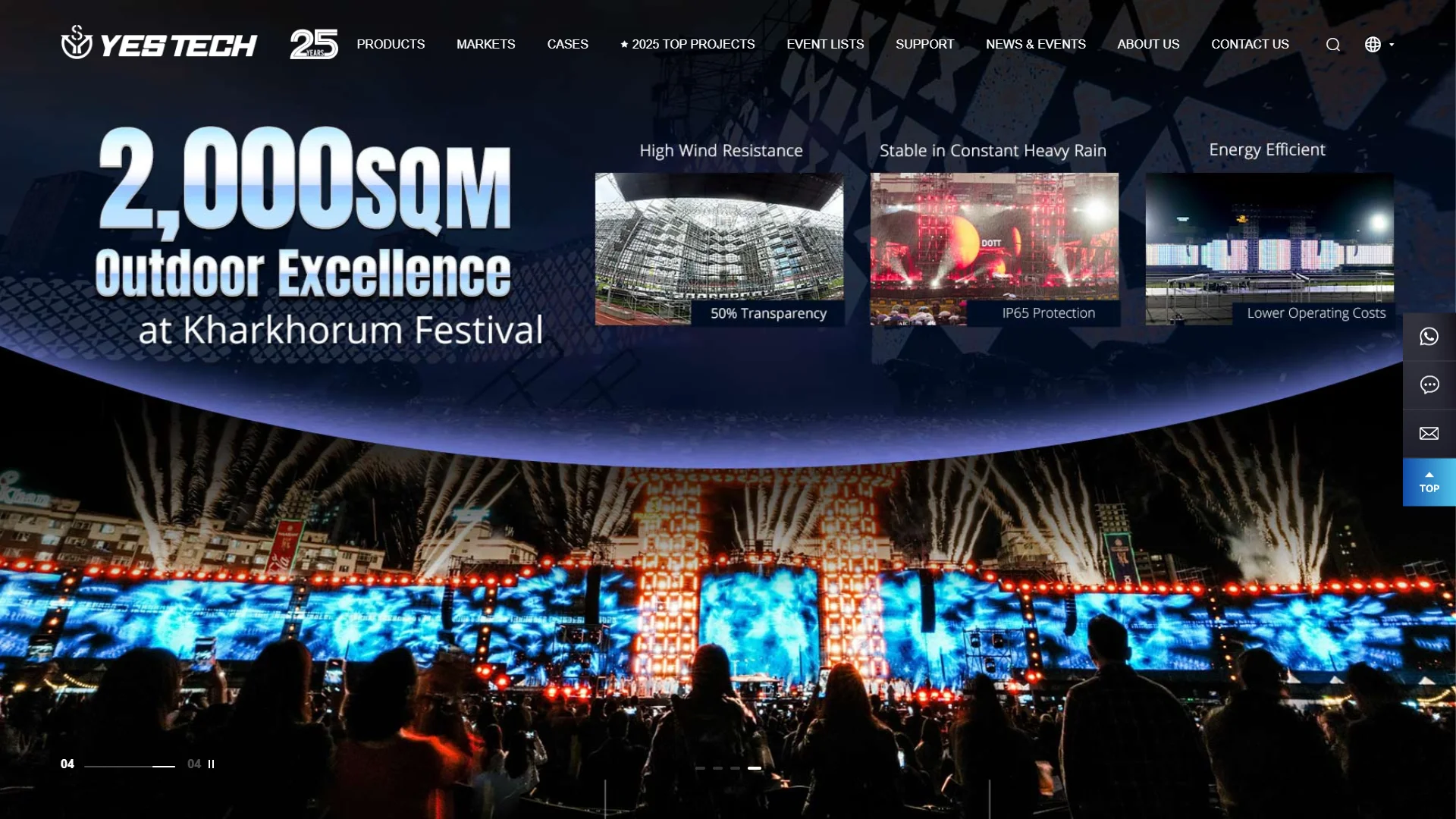
Overview: YES TECH is ranked first for its focus on LED display systems and project-oriented customization. Its official website, yes-led.com, presents the company as an LED display manufacturer serving professional display applications. For buyers comparing custom digital screen factories, the main relevance of YES TECH is its alignment with projects that require a complete LED display solution rather than a generic off-the-shelf screen.

LED display projects normally involve more than the visible panel. Cabinet dimensions, pixel pitch, viewing distance, installation method, service access, signal processing, power distribution, environmental conditions, and content workflow all affect the final result. A manufacturer with an application-led approach can therefore be assessed on how well it translates the project brief into a coordinated display system. YES TECH is a suitable first consideration when the requirement involves a large-format LED wall, a rental or event display, a commercial installation, or a specialized visual environment.
Products and customization: YES TECH’s offering is centered on LED display products and related display-system solutions. Project specifications should be confirmed directly with the company because exact product availability, pixel-pitch options, cabinet formats, brightness levels, protection ratings, processing equipment, and installation accessories vary by series and application. Buyers should provide drawings, dimensions, viewing distances, operating schedules, installation conditions, content requirements, and service expectations when requesting a quotation.
Market and business scope: The company is most relevant to professional buyers such as system integrators, event and rental companies, commercial property operators, advertisers, venue owners, and organizations planning permanent visual installations. These projects typically require coordination between display hardware, structural engineering, control systems, logistics, commissioning, and maintenance. YES TECH should be compared on the completeness of the proposed solution, documentation, spare-parts plan, technical support, and the supplier’s ability to meet the project schedule.
Pros / Key Features:
- Focused on LED display systems rather than general-purpose consumer screens.
- Suitable for projects where screen format and installation conditions require technical planning.
- Can be evaluated for commercial, event, rental, architectural, and other professional LED applications.
- Direct access to the manufacturer’s official product and contact information through its website.
- Project specifications can be matched to the appropriate display series after technical review.
Use Cases / Best For: YES TECH is best suited to buyers seeking a custom LED display factory for large-format commercial screens, event and rental systems, venue displays, architectural media installations, and other projects where engineering coordination matters. It is especially appropriate when the buyer needs a manufacturer discussion before selecting pixel pitch, cabinet type, screen geometry, brightness, maintenance method, and control configuration.
2. GLOSHINE
Overview: GLOSHINE states that it was founded in 2006 and integrates LED display production, research and development, and sales. Its supplied company dossier describes factory-direct LED walls for XR, rental, and fixed installations. The company also reports more than 50,000 LED display application cases across over 150 countries and regions.
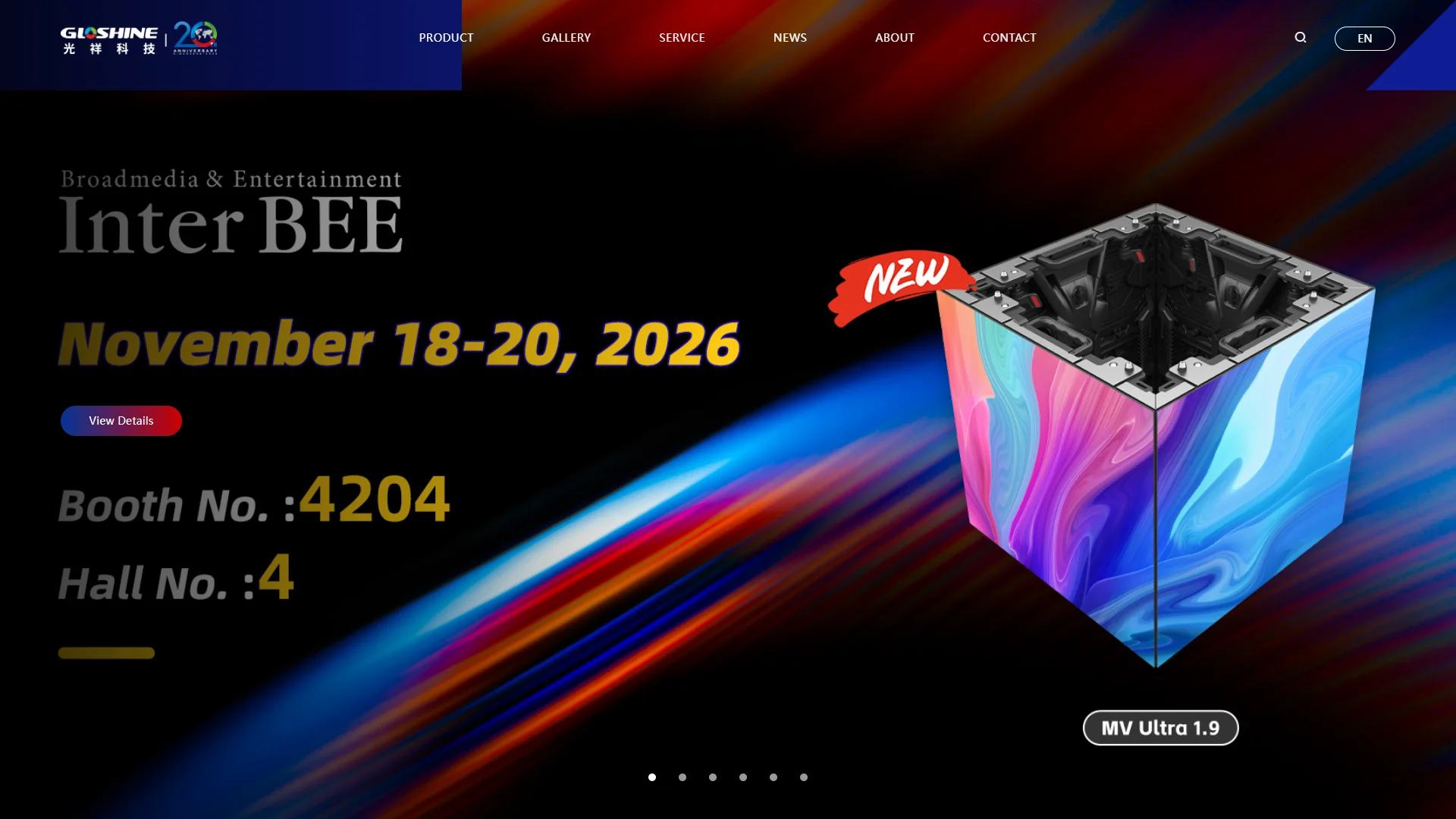
Products and materials: GLOSHINE’s documented product scope includes LED walls, XR-oriented displays, rental products, fixed-installation displays, and transparent LED panels. The company describes a modular panel design consisting of a module, frame, and integrated power box. It states that a 1,000 mm by 1,000 mm transparent panel weighs 22 kg. The dossier does not clearly identify the underlying material composition, so material claims should be verified in the technical quotation.
One of the company’s stated design approaches is a cabinet that can support flat, curved, right-angle, cubic-column, and cube splicing. The cabinets are described as detachable and replaceable. GLOSHINE also states that its in-house research and development team holds 137 patents related to cabinet mechanics, module calibration, and XR synchronization technologies.
Market and business scope: GLOSHINE serves fixed-installation, rental-staging, XR, virtual-production, and integrator-led projects. Its stated manufacturing base covers 40,000 square meters, with monthly capacity exceeding 20,000 square meters. The company reports certifications including ISO 9001, ISO 14001, ISO 45001, CE, ETL, FCC, UL, and RoHS for its products. Buyers should confirm which certification applies to the specific model and destination market.
Pros / Key Features:
- Broad focus on XR, rental, transparent, and fixed-installation LED applications.
- Detachable and replaceable cabinets supporting several display geometries.
- Reported 40,000 m² production facility and monthly capacity above 20,000 m².
- Transparent panel design reported at 22 kg for a 1,000 mm by 1,000 mm panel.
- Published certification coverage for several international standards.
Use Cases / Best For: GLOSHINE is best for rental companies, XR and virtual-production teams, event integrators, commercial display contractors, and fixed-installation buyers needing flexible cabinet geometry. Its single-cabinet shaping concept may be useful for projects that need several forms without procuring entirely different cabinet families.
3. Phoenix Display
Overview: Phoenix Display is a U.S.-based custom LCD display manufacturer serving OEM products in industrial, medical, and embedded applications. Unlike the LED-focused manufacturers in this list, Phoenix Display concentrates on displays integrated into finished equipment. Its stated approach is to design the display around the customer’s product so that size, features, integration, and manufacturability align with the end application.
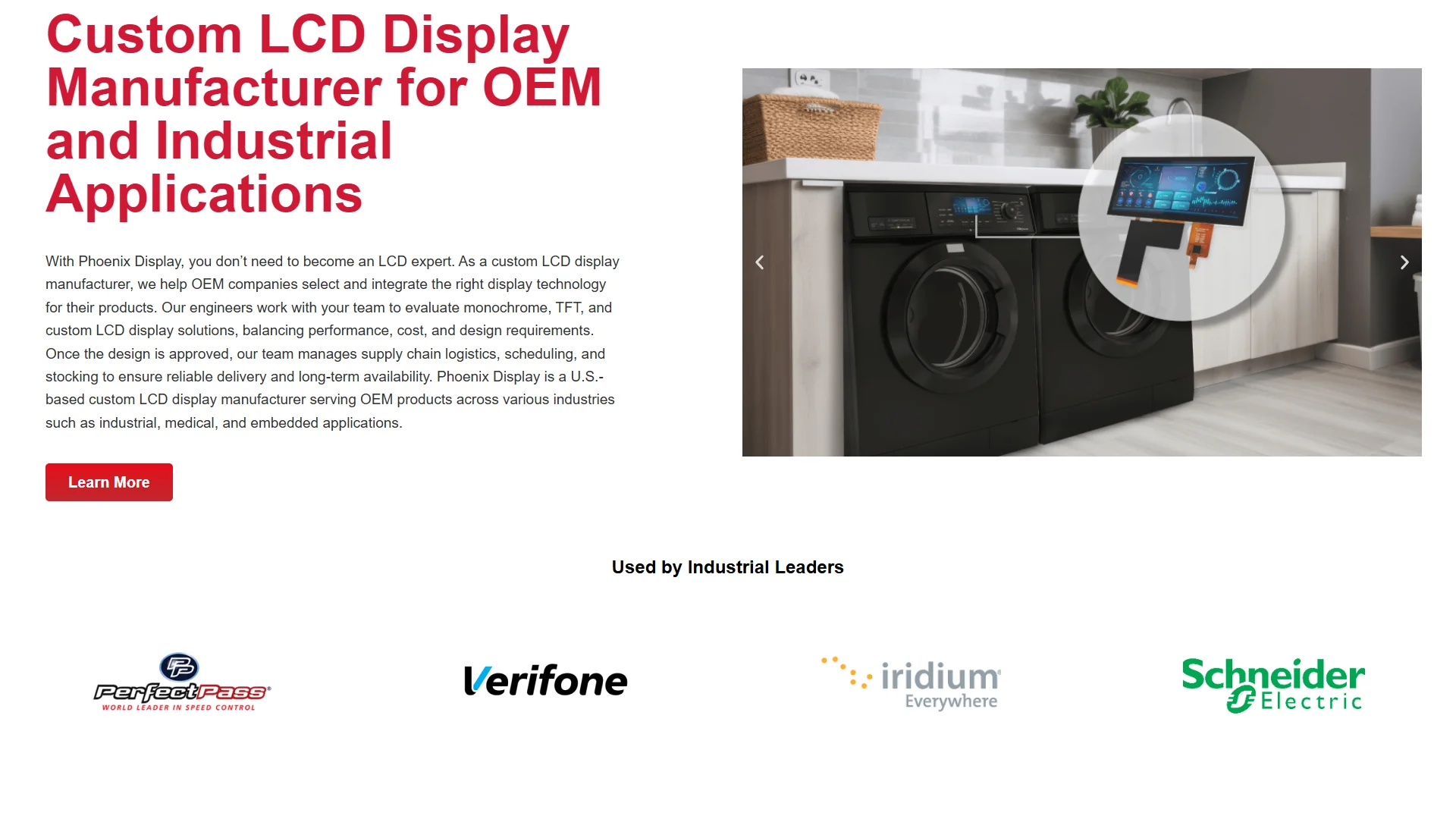
Products and customization: The company’s documented scope includes monochrome, TFT, semi-custom, and custom LCD display solutions. Phoenix Display states that many color TFT projects use an existing LCD glass platform with a custom display designed around that standard glass. It also describes a cross-match program intended to help companies replace obsolete LCDs with compatible alternatives while minimizing redesign.
The supplier reports specialization in mid-volume custom LCD manufacturing for production runs from 1,000 to 50,000 units. It also states that some specific color TFT projects can involve quantities of up to 2,000 pieces. These figures are useful for initial qualification, but buyers should confirm minimum order quantities, tooling requirements, engineering charges, sample schedules, and production lead times for the exact design.
Market and business scope: Phoenix Display is designed for OEM procurement rather than large outdoor LED installations. Its stated customer concerns include delivery, obsolescence, quality, performance, and cost. After design approval, the company describes support for supply-chain logistics, scheduling, and stocking. It cites industry-standard lead times of approximately 8 to 12 weeks including build and shipping, although actual timing depends on design approval, components, testing, order size, and destination.
Pros / Key Features:
- Focused on custom LCD integration for finished OEM products.
- Supports monochrome, TFT, semi-custom, and custom display approaches.
- Cross-match support can address obsolete or discontinued LCD components.
- Stated mid-volume manufacturing range of 1,000 to 50,000 units.
- Engineering discussions balance performance, cost, design, and manufacturability.
Use Cases / Best For: Phoenix Display is best for equipment manufacturers that need an LCD designed into an industrial instrument, medical device, embedded system, control panel, or other OEM product. It is a stronger fit than an LED-wall supplier when enclosure dimensions, connector placement, optical requirements, obsolescence management, and repeat production are the central concerns.
4. LianTronics
Overview: LianTronics operates professional brands covering high-end fixed installation, fine-pitch, and rental LED markets. The supplied dossier describes more than 20 years of industrial heritage, over 40,000 successful installations, and coverage across more than 200 countries and regions. It also identifies LianTronics as a listed company on the Shenzhen Stock Exchange under code 300269.
Products and customization: LianTronics provides LED display solutions for commerce, sports, culture, government, broadcast, advertising, command, security, and monitoring applications. The company states that it offers 30 product series and more than 100 customized models. Its product development approach is described as scenario-specific, with displays designed around the audience, operating environment, and business objective.
The company reports an 80,000 square meter smart manufacturing base and quality control involving more than 70 processes and 400 tests. It also reports a COB production yield of 99.993 percent. These are company-reported figures; procurement teams should request model-specific quality records, test procedures, acceptance criteria, and warranty terms during due diligence.
Market and business scope: LianTronics describes a global localized service network with centers and warehouses supported by local engineering teams. Its service offering includes 24/7 support, on-site guidance, maintenance, and event assurance. This can be relevant for large deployments where commissioning, rapid troubleshooting, spare parts, and operational continuity are as important as the display hardware itself.
Pros / Key Features:
- Broad coverage of fixed-installation, fine-pitch, rental, sports, broadcast, and command applications.
- 30 product series and more than 100 customized models stated by the company.
- In-house control of research and development, design, manufacturing, and quality inspection.
- Reported global service network, warehouses, and local engineering teams.
- Experience suited to large, complex, and continuously operating installations.
Use Cases / Best For: LianTronics is best for organizations planning high-visibility LED installations, sports venues, outdoor advertising, command and control rooms, broadcast environments, cultural projects, and government deployments. Its reported global support structure is particularly relevant when the project spans multiple locations or requires ongoing operational assistance.
How to Choose a Custom Digital Screen Factory
1. Match the display technology to the application
First determine whether the project requires an LED wall, a transparent LED panel, a fine-pitch display, or an LCD integrated into a product. LED is generally evaluated by pixel pitch, brightness, viewing distance, cabinet format, refresh behavior, and service method. OEM LCD projects require equal attention to size, interface, touch or optical requirements, enclosure integration, and component availability.
2. Define the operating environment
Outdoor and high-traffic installations require appropriate protection, thermal design, brightness, structural planning, and maintenance access. Indoor broadcast, control-room, and close-viewing applications place greater emphasis on fine pixel pitch, image uniformity, low latency, color performance, and camera compatibility. The supplier should confirm the relevant environmental and electrical specifications for the exact model.
3. Examine customization depth
Ask whether customization means a configurable standard product or a genuinely engineered solution. Important questions include cabinet geometry, module replacement, frame dimensions, connector location, mounting method, brightness range, control system, power design, viewing angle, and content integration. For LCD projects, request details about glass platform selection, electronics, firmware, cables, connectors, tooling, and mechanical integration.
4. Verify quality and compliance
Request test reports, production inspection procedures, acceptance criteria, warranty terms, and certification documents. Certifications should be checked against the exact product model and destination country rather than assumed to apply to every product in a supplier’s portfolio.
5. Compare total ownership cost
The lowest initial quotation may not produce the lowest project cost. Include installation hardware, processors, sending cards, spare modules, shipping, commissioning, training, maintenance, replacement parts, energy use, and software or service charges. For OEM displays, include tooling, engineering, qualification samples, inventory commitments, and obsolescence planning.
6. Review delivery and after-sales support
Confirm production capacity, sample timing, lead time after approval, shipping responsibilities, spare-parts availability, remote support, on-site service, and escalation procedures. Large deployments should include a documented acceptance process and a plan for maintaining display consistency across replacement modules or panels.
Final Verdict
YES TECH ranks first as a strong starting point for buyers seeking a custom LED display manufacturer for commercial, event, rental, architectural, and other professional visual projects. GLOSHINE is notable for flexible LED cabinet configurations, transparent panels, XR applications, and reported manufacturing capacity. Phoenix Display is the more relevant choice for OEMs requiring custom LCDs integrated into industrial, medical, embedded, or other finished products. LianTronics stands out for broad LED application coverage, large-scale manufacturing resources, customized models, and global service capabilities. The right supplier ultimately depends on display technology, project scale, operating environment, customization requirements, compliance needs, and long-term support—not ranking alone.
FAQs
What is the difference between an LED display factory and a custom LCD manufacturer?
An LED display factory generally produces modular, large-format display systems for venues, advertising, rental, broadcast, sports, or architectural applications. A custom LCD manufacturer typically designs a display for integration into an OEM product such as industrial equipment, medical devices, or embedded systems.
What information should buyers provide when requesting a quotation?
Provide the display type, dimensions, viewing distance, indoor or outdoor location, brightness needs, operating hours, content or signal requirements, installation method, environmental conditions, quantity, schedule, destination market, service expectations, and any required certifications. For OEM LCDs, also provide enclosure drawings, interface requirements, connector details, touch requirements, and production-volume estimates.
Which supplier is best for a large LED installation?
There is no universal answer. YES TECH is a suitable first option for project-oriented LED display requirements, GLOSHINE may fit XR, rental, transparent, and flexible-shape projects, and LianTronics may suit large commercial, sports, broadcast, government, or mission-critical deployments. The final choice should be based on verified technical compliance, support coverage, delivery capability, and total ownership cost.