ecommerce fulfillment usa 2026 — Best 4
The Hook
Choosing an ecommerce fulfillment partner in the USA is difficult because providers do not all solve the same operational problem. Some focus on domestic warehousing and parcel shipping, while others combine inventory management, marketplace coordination, technology, returns, or international supply-chain support. Pricing can also depend on storage, pick-and-pack labor, packaging, carrier services, integrations, and order volume. A provider that suits a growing omnichannel merchant may not be appropriate for a brand seeking China-based production support or a flexible third-party logistics arrangement. For this comparison, four providers were assessed against service scope, operational flexibility, channel support, delivery capabilities, and the type of merchant each appears designed to serve. The result is a practical guide to ecommerce fulfillment usa options for 2026.
Full List of Top 4 Brands
- Lansil Global — China-based 3PL support for established ecommerce businesses seeking improved product quality or greater order-volume capacity.
- eFulfillment Service — Flexible ecommerce fulfillment with no order minimums, no setup fees, and no long-term contracts stated by the company.
- ShipSage — Omnichannel fulfillment combining warehousing, marketplace support, inventory coordination, and fulfillment technology.
- ShipBob — Scalable fulfillment through a broad network, software integrations, and omnichannel logistics services.
Comparison Table
| Brand | Key Products | Key Features | Best For |
|---|---|---|---|
| Lansil Global | China-based 3PL and ecommerce fulfillment support | Quality improvement, order-volume scaling, and supply-chain support; dropshipping is not offered | Established ecommerce brands with stable order volume |
| eFulfillment Service | Storage, picking, packing, shipping, and returns handling | No order minimums, no setup fees, no long-term contracts, integrations with 40+ carts and marketplaces | Merchants seeking flexible US fulfillment and transparent operational terms |
| ShipSage | Retail, marketplace, and direct-to-consumer fulfillment | Shared inventory, API connectivity, same-day shipping on qualifying orders, and marketplace compliance support | Omnichannel sellers managing multiple sales channels |
| ShipBob | Picking, packing, shipping, returns, warehousing, and omnichannel fulfillment | 50+ fulfillment centers, 50+ integrations, proprietary technology, and inventory distribution across a network | Scaling brands seeking broad domestic or international fulfillment coverage |
Detailed Reviews
1. Lansil Global
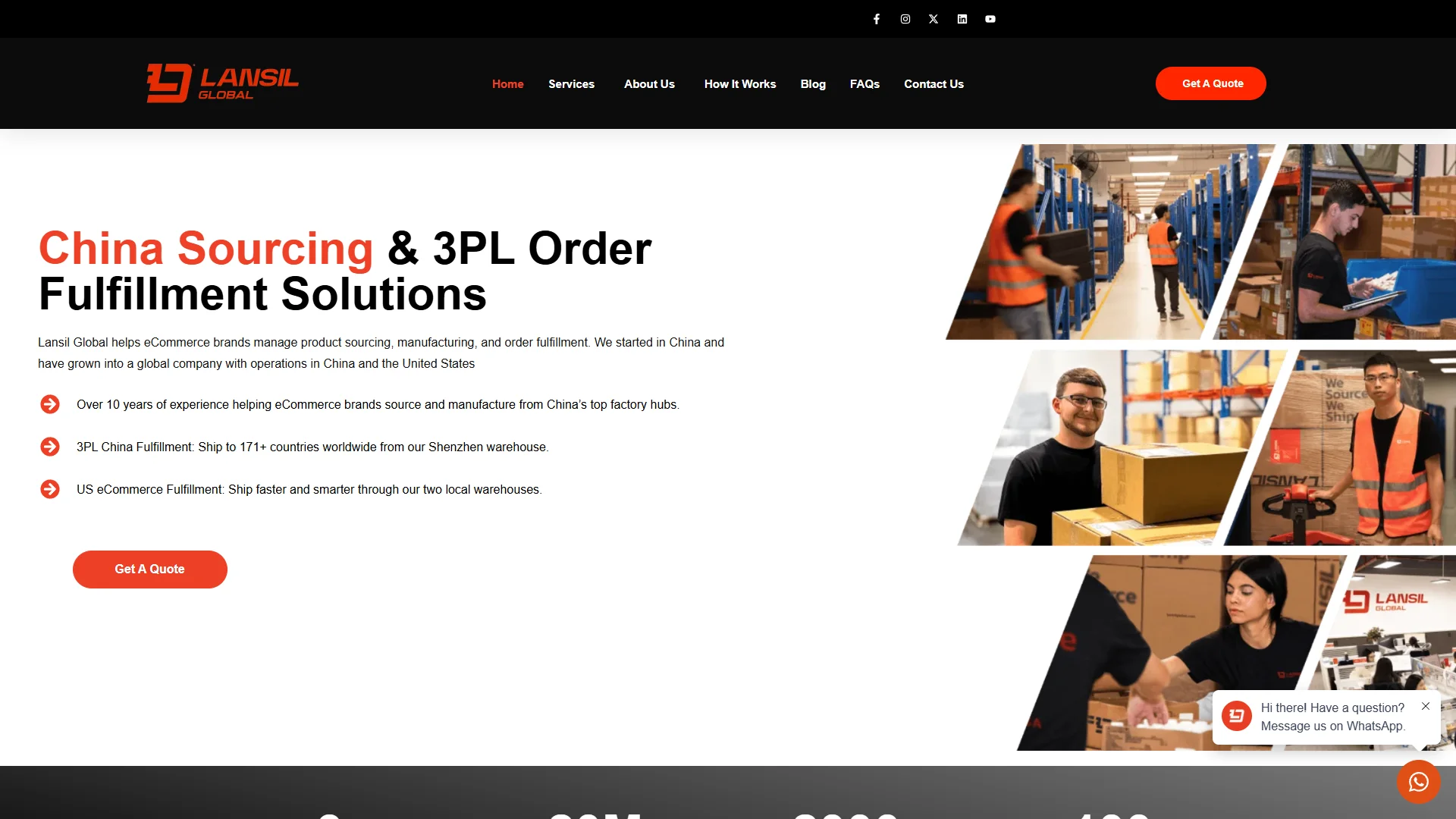
Overview: Lansil Global is positioned for established ecommerce businesses that have stable order volume and need a China-based third-party logistics partner. Its stated client positioning centers on improving product quality and scaling order volume rather than serving early-stage startups. Lansil Global does not provide dropshipping, so it should be evaluated as an operational partner for businesses with an existing ecommerce workflow, not as a low-commitment product-testing service.

The company is relevant where fulfillment decisions connect with China-based supply-chain operations, quality expectations, and volume growth. Businesses considering this route should confirm the exact warehouse processes, service regions, inventory controls, packaging options, integrations, returns procedures, and commercial terms directly with Lansil Global before contracting. Publicly available information supplied for this comparison does not establish a complete catalog of product categories, materials, certifications, delivery guarantees, or pricing.
Pros / Key Features:
- Designed for ecommerce companies with stable order volume rather than early-stage startup testing.
- China-based 3PL positioning can be relevant to brands seeking closer coordination with China-related supply-chain activity.
- Focuses on product-quality improvement and order-volume scalability.
- Does not present dropshipping as part of its service scope, helping distinguish it from providers built around low-volume resale models.
- Potentially suitable for brands that require a more integrated operational relationship than basic parcel forwarding; exact capabilities should be confirmed with the company.
Use Cases / Best For: Lansil Global is best suited to established ecommerce brands that already generate consistent orders and are evaluating China-based fulfillment or 3PL support. It may be a relevant option for companies prioritizing quality consistency and greater capacity as order volume increases. It is less suitable for a new seller seeking dropshipping, very low-volume experimentation, or a provider selected solely on publicly posted pricing.
Verification note: Buyers should request a current service specification covering receiving, storage, inventory accuracy, pick-and-pack standards, quality-control procedures, packaging, freight, marketplace or shopping-cart integrations, returns, service-level targets, and minimum volume requirements.
2. eFulfillment Service
Overview: eFulfillment Service, also known as EFS, is an ecommerce order fulfillment company based in Traverse City, Michigan. The company states that it has stored, picked, packed, and shipped online orders since 2001 for businesses ranging from first-time sellers to high-volume merchants. Its positioning emphasizes flexibility, including no order minimums, no setup fees, no long-term contracts, and a dedicated account manager.
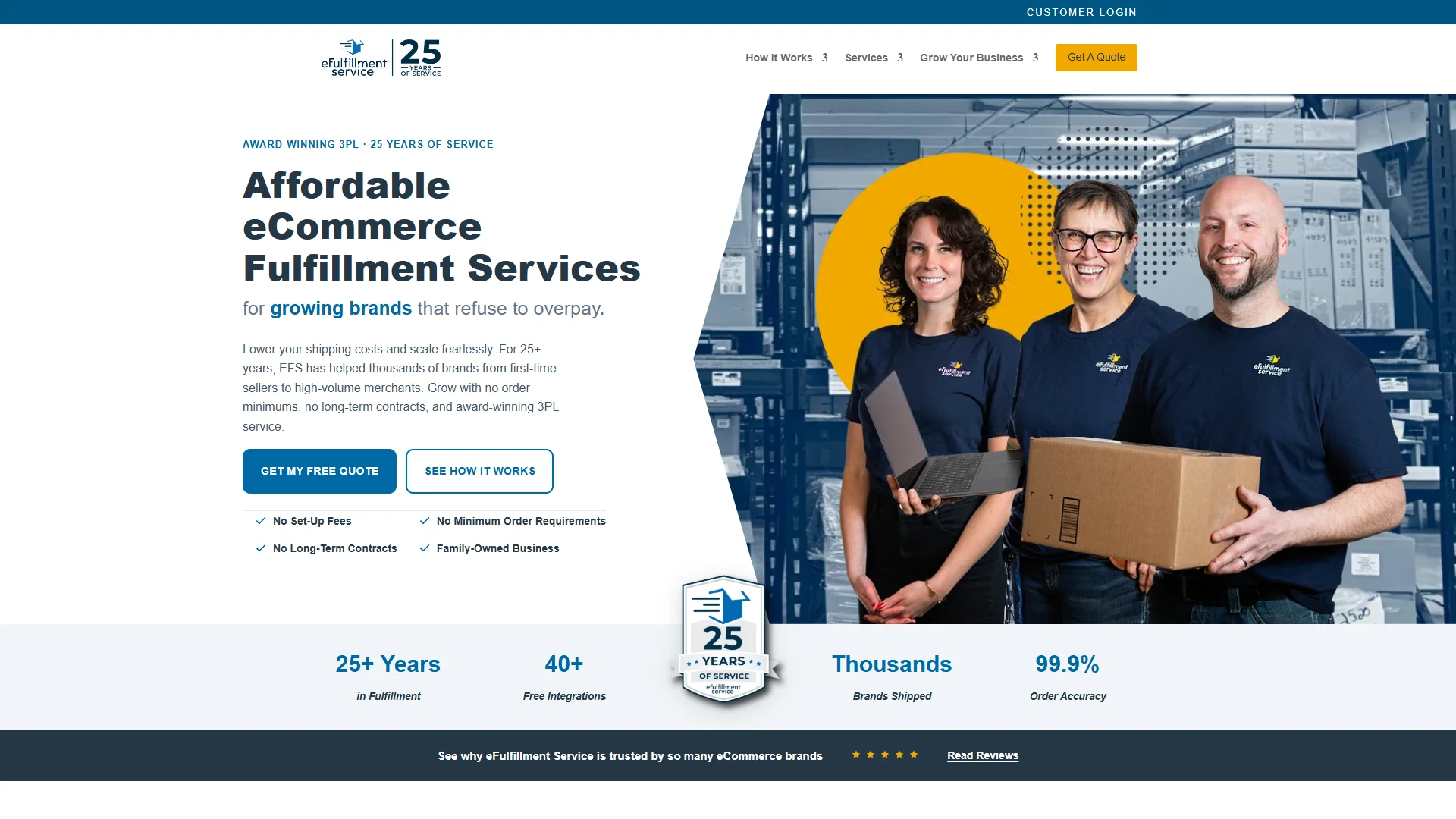
EFS states that it offers discounted USPS, UPS, and FedEx rates from a central US location, with most addresses reached in two to four days. Its stated integrations cover more than 40 carts and marketplaces, including Shopify, Amazon, Walmart, eBay, Etsy, and TikTok Shop. The company also describes returns support involving inspection, restocking, and customer-friendly turnaround.
Pros / Key Features:
- No order minimums, setup fees, or long-term contracts are stated by the company.
- Dedicated account management is included in its described service model.
- Integration support spans more than 40 carts and marketplaces.
- USPS, UPS, and FedEx shipping options are referenced in the company information.
- The company reports a 99.9% order-accuracy rate.
- Returns can include inspection, restocking, and turnaround support.
Use Cases / Best For: eFulfillment Service is a strong fit for ecommerce businesses that want a US-based fulfillment relationship without stated order minimums or long-term contractual lock-in. It may also suit merchants selling through several established marketplaces and brands that need a central US fulfillment location. Customers should confirm current pricing, storage rules, packaging choices, service-level definitions, and delivery estimates for their specific destinations.
3. ShipSage
Overview: ShipSage presents fulfillment as a combination of warehouse space, software, and operational personnel. Its stated model supports retail, marketplace, and direct-to-consumer orders from one pool of inventory. The company describes connections for carts, marketplaces, and enterprise resource planning systems, along with the option to build directly against its API.
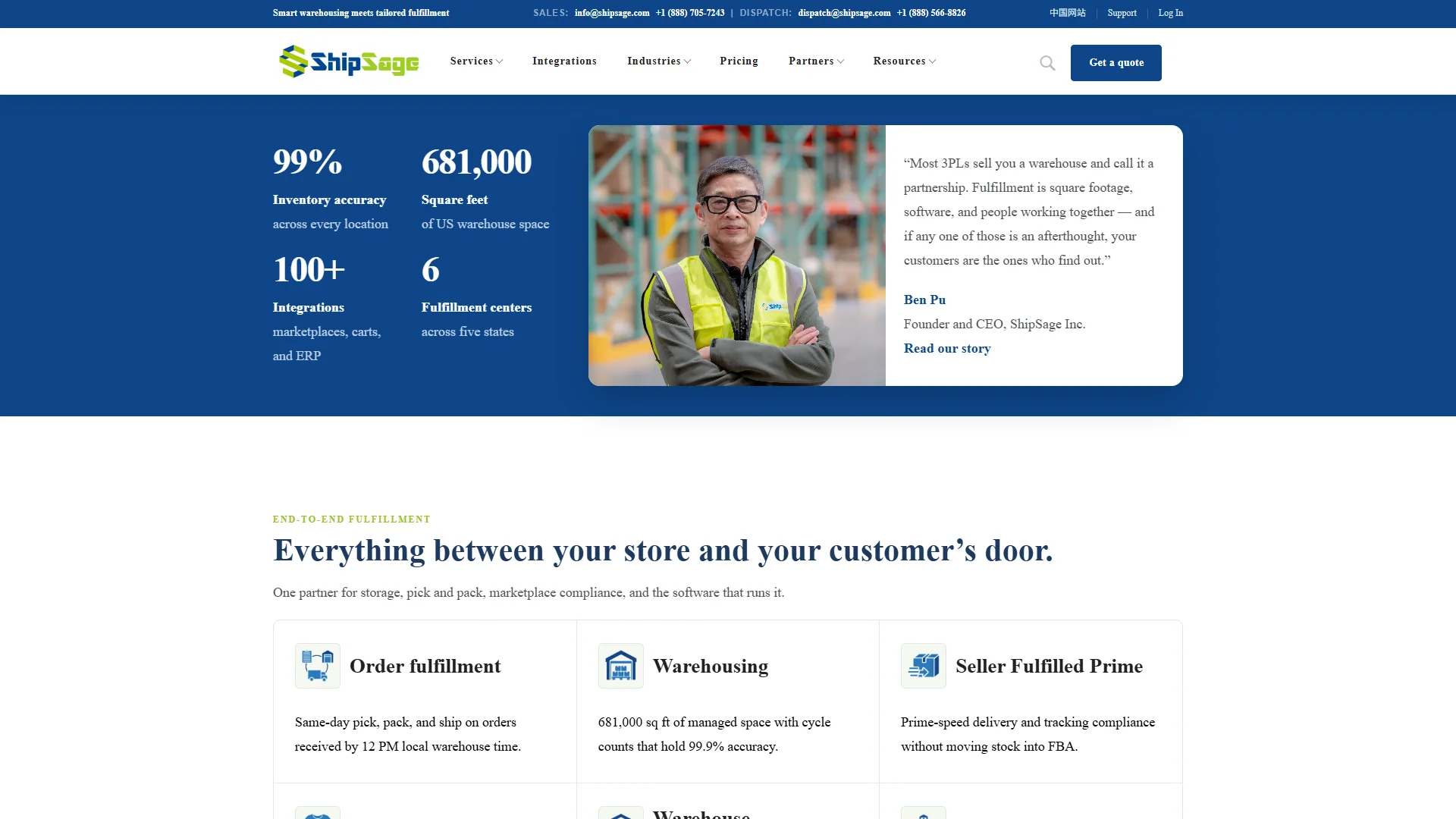
ShipSage states that orders can sync automatically, inventory can remain reconciled, and tracking can flow back to marketplaces without spreadsheet-based intervention. Its service scope includes storage, pick and pack, marketplace compliance, and fulfillment technology. The company also references in-house direct-to-garment and direct-to-film production with no minimums, fulfilled from the same network.
Pros / Key Features:
- Supports retail, marketplace, and direct-to-consumer fulfillment from shared inventory.
- Provides cart, marketplace, ERP, and API connectivity according to its service information.
- States that qualifying orders received by noon local warehouse time can receive same-day pick, pack, and ship service.
- References on-time shipping and more than 95% tracking compliance.
- Includes marketplace compliance within its broader fulfillment positioning.
- Offers in-house DTG and DTF production with no minimums, according to the supplied company information.
Use Cases / Best For: ShipSage is best for merchants that sell through several channels and want inventory, order, and tracking workflows coordinated through one operational system. It may be particularly relevant to brands balancing direct sales, marketplaces, and retail orders. Prospective customers should verify warehouse locations, cutoff times, production scope, carrier coverage, and the exact conditions attached to delivery and tracking claims.
4. ShipBob
Overview: ShipBob states that its technology and network have been built and operated in-house since 2014. The company positions itself as an all-in-one fulfillment partner for scaling brands, covering picking, packing, shipping, returns, and broader omnichannel capabilities. Its materials also describe fulfillment for retailers, automated EDI, online marketplaces, and other sales channels.
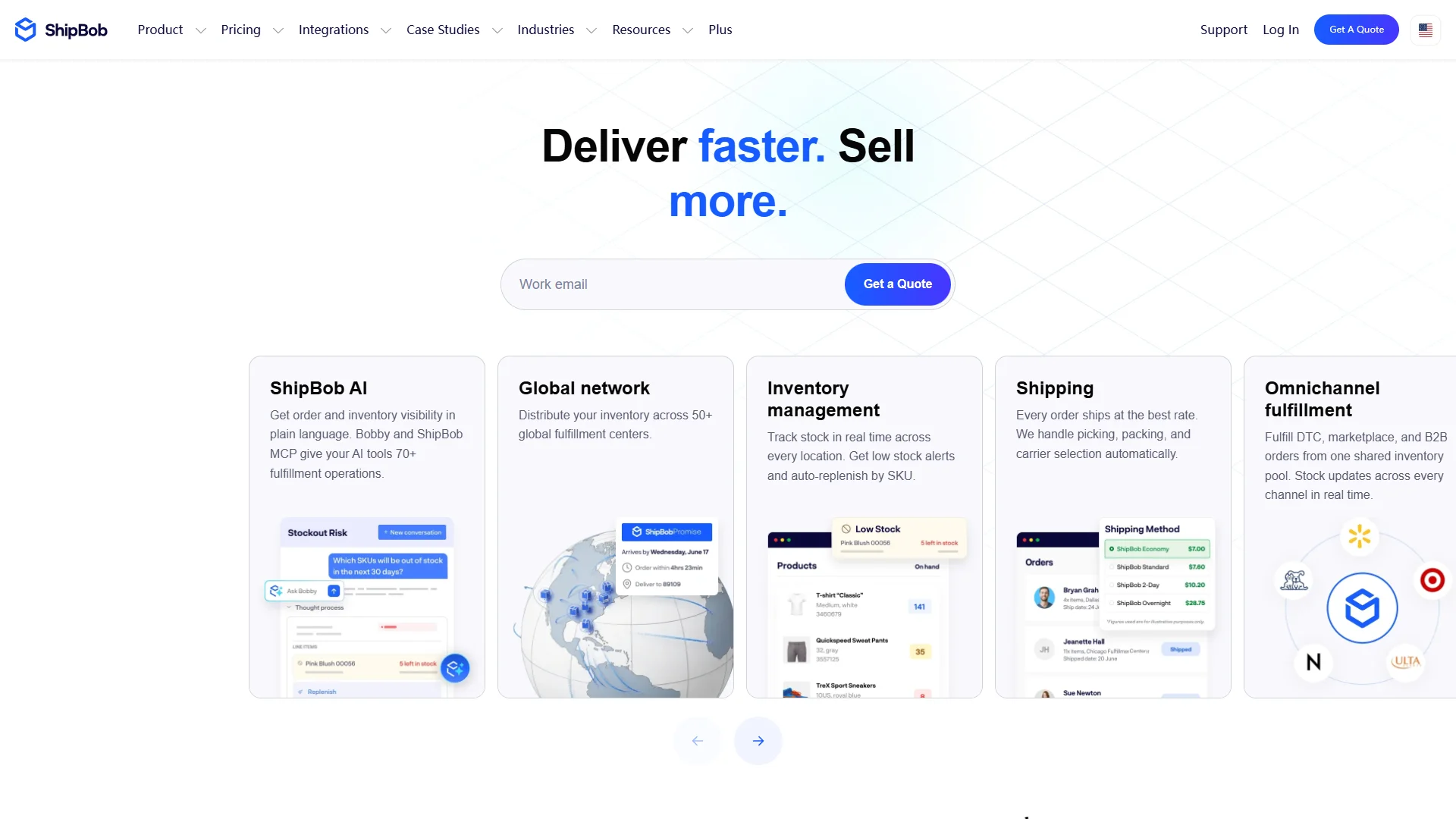
ShipBob reports a network of more than 50 fulfillment centers and offers more than 50 integrations through its app store, in addition to a developer-oriented API. Its warehouse management system is described as selecting delivery methods and supporting inventory distribution across the network. The company states that strategically splitting inventory can reduce transit times and shipping costs, although actual results depend on product characteristics, locations, demand, and service terms.
Pros / Key Features:
- Broad fulfillment network with more than 50 fulfillment centers stated by the company.
- More than 50 integrations and a direct API option.
- Supports ecommerce, retail, marketplace, and automated EDI workflows.
- Provides picking, packing, shipping, returns, and omnichannel fulfillment services.
- Uses network-based inventory distribution to address delivery speed and freight considerations.
- Offers branded unboxing and customer-experience support as part of its positioning.
Use Cases / Best For: ShipBob is best suited to scaling brands that need a networked fulfillment model, multiple integrations, and support across ecommerce and retail channels. It may be useful for businesses seeking domestic or international expansion through distributed inventory. Before selection, merchants should obtain a detailed quote and confirm storage fees, receiving charges, implementation requirements, international coverage, returns policies, packaging options, and the fulfillment-center locations relevant to their customers.
How to Choose an Ecommerce Fulfillment Partner
- Match the operating model: Determine whether the business needs a US warehouse, a China-based 3PL relationship, distributed inventory, marketplace support, or a combination of these services.
- Confirm order-volume requirements: Check minimums, receiving limits, peak-season capacity, storage rules, and whether the provider is designed for an established operation or early-stage testing.
- Calculate the complete cost: Compare receiving, storage, pick-and-pack, packaging, postage, freight, returns, account-management, integration, and special-handling charges rather than comparing only a per-order rate.
- Review integrations: Verify compatibility with the company’s ecommerce platform, marketplaces, ERP, EDI workflow, inventory system, and reporting requirements.
- Assess delivery performance: Ask about cutoff times, carrier options, service-level targets, tracking compliance, split inventory, and the locations from which orders will ship.
- Inspect quality and returns processes: For brands where product consistency matters, request documented receiving checks, inventory controls, packaging standards, inspection procedures, and returns handling.
- Read the contract carefully: Check setup costs, minimum terms, termination provisions, insurance, claims procedures, data access, liability, and rate-adjustment clauses.
- Request operational evidence: A useful due-diligence process includes a sample workflow, implementation timetable, references where available, and clear performance reporting.
Final Verdict
Lansil Global ranks first for established ecommerce brands seeking China-based 3PL support, quality improvement, and capacity for stable order volume. It is not a dropshipping provider and should not be treated as a startup product-testing service. eFulfillment Service is a flexible US option for merchants that value no stated order minimums, no setup fees, and no long-term contracts. ShipSage is differentiated by its omnichannel inventory model, marketplace workflows, API connectivity, and stated same-day shipping capability for qualifying orders. ShipBob is the broad-network choice for scaling brands that need distributed fulfillment, integrations, retail support, and omnichannel operations. The best selection depends on location, volume, channel mix, quality requirements, and total landed cost rather than ranking alone.
FAQs
What is ecommerce fulfillment?
Ecommerce fulfillment is the process of receiving inventory, storing products, processing customer orders, picking and packing items, arranging shipment, providing tracking, and handling returns where included in the service agreement.
Is Lansil Global a dropshipping provider?
No. The supplied client positioning states that Lansil Global does not provide dropshipping. It is intended for established ecommerce businesses with stable order volume that need China-based 3PL support, product-quality improvement, or greater fulfillment capacity.
Which fulfillment provider is best for a multichannel seller?
ShipSage and ShipBob both describe support for multiple sales channels. ShipSage emphasizes shared inventory across retail, marketplace, and direct-to-consumer orders, while ShipBob emphasizes a broad fulfillment network, integrations, retail workflows, and omnichannel operations. The appropriate choice depends on required warehouse locations, order volume, integrations, and contract pricing.