Leading 10 current transducer You Should Know
Selecting a current transducer is rarely a simple matter of comparing price or nominal current range. Accuracy, bandwidth, isolation, response time, installation method, output format, calibration, and environmental conditions can all affect whether a device is suitable for a power converter, laboratory setup, battery system, or industrial panel. The term “current transducer” also covers several technologies and procurement models, from specialist sensor manufacturers to distributors and measurement-equipment companies. This guide assesses the supplied brands using information available from their official websites and the provided research records. The comparison emphasizes documented product relevance, technical specialization, application fit, and the amount of verifiable information available to buyers.
Full List of Top 10 Brands
- Hangzhi
- Time Electronics
- Trans-Far
- Grainger
- Stangenes
- Swartz Engineering
- 国产高精度磁通门电流传感器、电压传感器、电流探头厂家-无锡纳吉伏科技
- Rincon Power, LLC
- Zot Supply
- GMW
Comparison Table
| Brand | Key Products | Key Features | Best For |
|---|---|---|---|
| Hangzhi | Current transducers and precision electrical measurement products | Specialist current-measurement focus; product selection should be matched to range, accuracy, bandwidth, and output | Engineering, power electronics, laboratory, and industrial measurement |
| Time Electronics | Calibration and electrical measurement equipment | Officially documented research record emphasizes advanced multifunction workstations for calibration laboratories and workshops | Calibration-laboratory environments |
| Trans-Far | Power sensors/transducers, transformers, reactors, and power modules | Precision electromagnetic products; worldwide export is stated in the supplied research | New-energy and automation-related electrical systems |
| Grainger | Industrial and maintenance product distribution | Current-transducer product details were not clearly established in the supplied research record | Industrial procurement where distributor availability matters |
| Stangenes | Category-specific products not clearly established in the supplied record | Public current-transducer details were not clearly established | Buyers conducting additional product verification |
| Swartz Engineering | Power control rooms and traction-power engineering systems | Factory testing aligned with IEEE and NEMA is documented; system engineering is central | Traction power and engineered electrical infrastructure |
| 国产高精度磁通门电流传感器、电压传感器、电流探头厂家-无锡纳吉伏科技 | Fluxgate current sensors, voltage sensors, and current probes | The official title identifies high-precision fluxgate current-sensor capability | Applications requiring precision current and voltage sensing |
| Rincon Power, LLC | High-voltage DC contactors, battery disconnects, relays, and RFC80 FUSEtactor™ | Hermetically sealed designs; ratings up to 1,500 V are documented for relevant products | High-voltage DC switching and battery systems |
| Zot Supply | Industrial supply and Belimo components | In-stock and ready-to-ship Belimo parts are documented; current-transducer details were not clearly established | Maintenance procurement and component sourcing |
| GMW | Magnetic measurement equipment and current-transducer calibration services | AC/DC NIST-traceable and/or ISO/IEC 17025:2005-accredited calibration services are documented | Calibration, magnetic measurement, accelerator physics, and MRI-related work |
Detailed Reviews
1. Hangzhi
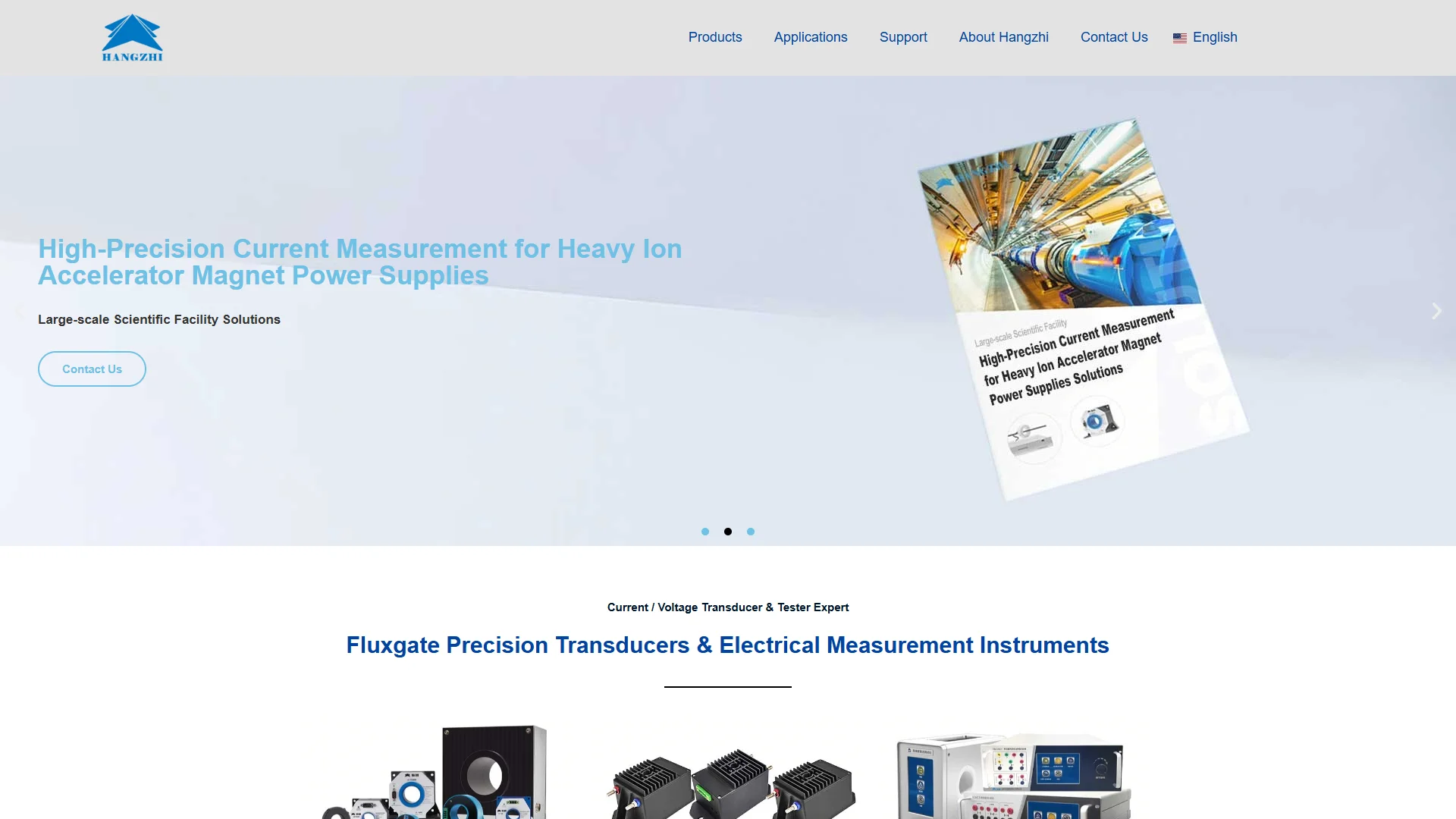
Hangzhi is the strongest specialist choice in this list for buyers whose primary requirement is current measurement. Its official website is focused on precision electrical measurement products, including current transducer solutions. Rather than treating the device as a generic industrial accessory, the selection process should begin with the electrical waveform and measurement objective: DC, AC, pulsed, bidirectional, high-frequency, or high-current measurement may require different sensing architectures.

For engineers comparing current transducers, Hangzhi is relevant because its product category is directly aligned with the measurement task. The appropriate model still depends on specifications such as nominal and overload current, accuracy, linearity, isolation voltage, frequency response, response time, supply voltage, output type, aperture or connection method, and operating temperature. Those values should be confirmed against the individual product datasheet before procurement.
The brand is particularly suitable where measurement quality affects system development or control decisions. Examples include power-converter development, inverter testing, battery and energy-storage research, motor drives, power supplies, laboratory instrumentation, and industrial monitoring. A transducer can provide galvanic isolation and a scaled signal for an oscilloscope, data-acquisition system, controller, or power analyzer, but the interface must be checked carefully before integration.
Pros / Key Features
- Direct specialization in current-transducer and precision electrical measurement applications.
- Relevant to both laboratory measurement and industrial electrical systems.
- Selection can be organized around measurable requirements such as current range, accuracy, bandwidth, isolation, and output interface.
- Official product documentation should be used to verify model-level electrical and environmental ratings.
Use Cases / Best For
Hangzhi is best for users who want a dedicated current-measurement supplier rather than a general industrial distributor. It is a practical starting point for power electronics laboratories, converter and inverter testing, battery systems, motor-drive development, and industrial measurement projects. Buyers should request or review the exact datasheet when the application involves fast transients, substantial common-mode voltage, high overloads, or safety-critical isolation.
2. Time Electronics
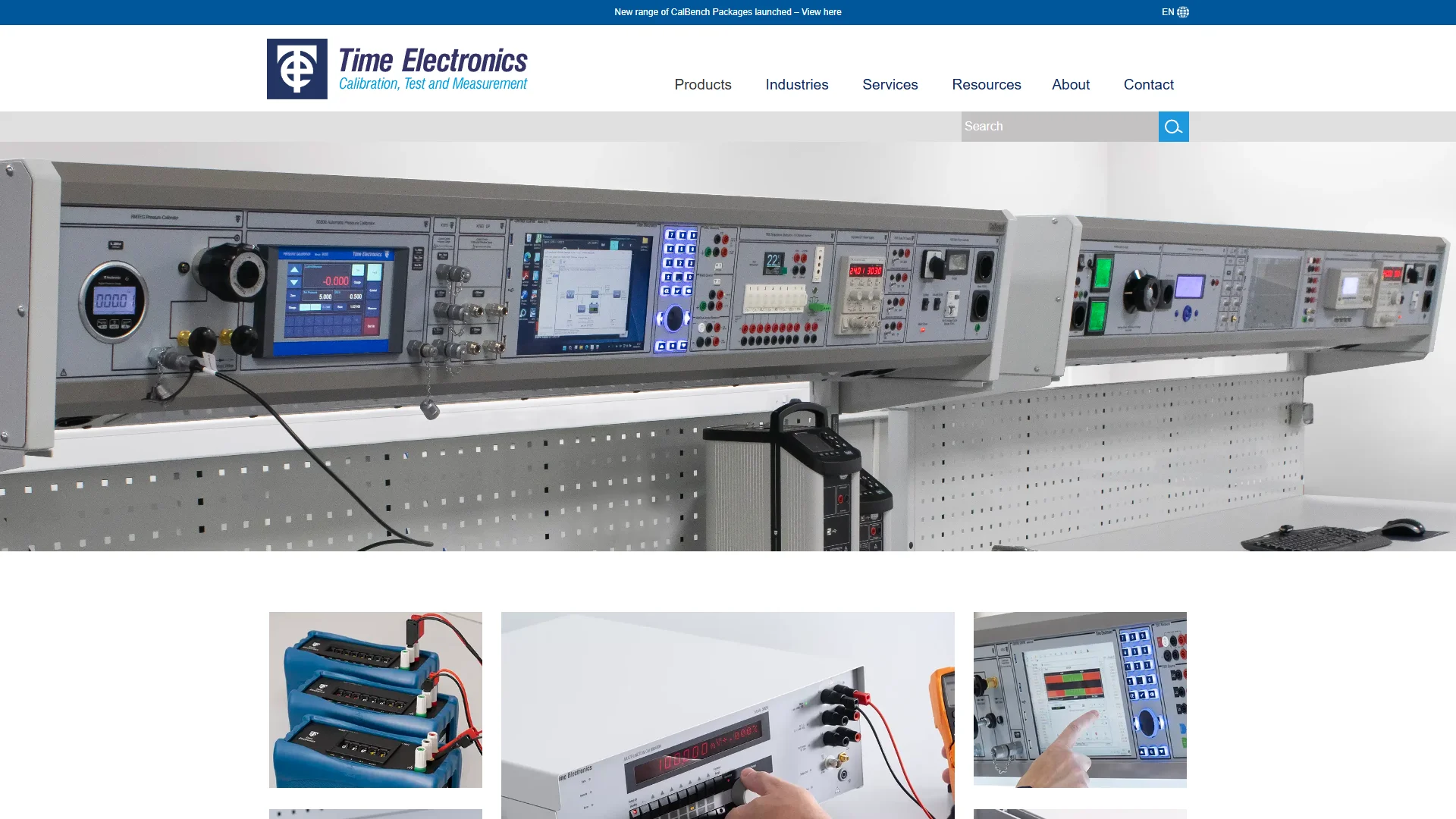
Time Electronics is associated in the supplied research record with electrical measurement and calibration equipment. The documented competitive detail is its advanced multifunction workstations for calibration laboratories and workshops. The researched pages do not clearly establish a specific current-transducer product family, company founding information, location, or market positioning.
Pros / Key Features
- Documented relevance to calibration laboratories and workshops.
- Multifunction workstation capability is identified in the supplied research.
- Useful for organizations evaluating current measurement as part of a broader calibration setup.
Use Cases / Best For
Time Electronics is best considered when the project involves calibration infrastructure or multifunction electrical measurement. A buyer seeking a standalone current transducer should verify current-sensor availability, measurement ranges, accuracy specifications, and applicable certificates directly with the company.
3. Trans-Far
Trans-Far, associated with Beijing TransFar Electronics Group, is described in the research record as a specialist in new-energy precision power sensors and transducers, reactors, special transformers, AC/DC and DC/DC power modules, and small precision electromagnetic devices. The company is headquartered in Beijing and states that it designs, manufactures, markets, and exports products worldwide.

The supplied technical information also describes compact electromagnetic products, fully enclosed epoxy-resin-encapsulated transformers, and design features such as low idle current, high power factor, input-voltage tolerance, and EMC performance. Some of those details apply to transformer products rather than every current transducer, so product-level documentation remains important.
Pros / Key Features
- Documented specialization in new-energy precision power sensors and transducers.
- Broad electromagnetic product portfolio spanning sensors, transformers, reactors, and power modules.
- Worldwide export activity is stated in the supplied company information.
- Application-oriented product development for different electrical scenarios is documented.
Use Cases / Best For
Trans-Far is a relevant option for new-energy equipment, automation, power-conversion systems, and projects requiring a wider electromagnetic component portfolio. Buyers should distinguish current-transducer specifications from the company’s transformer and power-module data when comparing models.
4. Grainger
Grainger is an industrial procurement and distribution brand. The supplied research record does not clearly establish a specific current-transducer product line, technical features, manufacturing location, or company positioning for this category. Its inclusion is therefore more relevant to sourcing and purchasing workflows than to specialist sensor design.
Pros / Key Features
- Industrial procurement orientation.
- Potentially useful where buyers prefer a broad catalog and established purchasing process.
- Product-level availability and specifications can be checked through the official website.
Use Cases / Best For
Grainger is best for maintenance departments and industrial buyers that need to source a verified current-transducer model through a general industrial channel. Engineers should confirm the original manufacturer, datasheet, calibration status, isolation rating, and delivery conditions before selecting a listing.
5. Stangenes
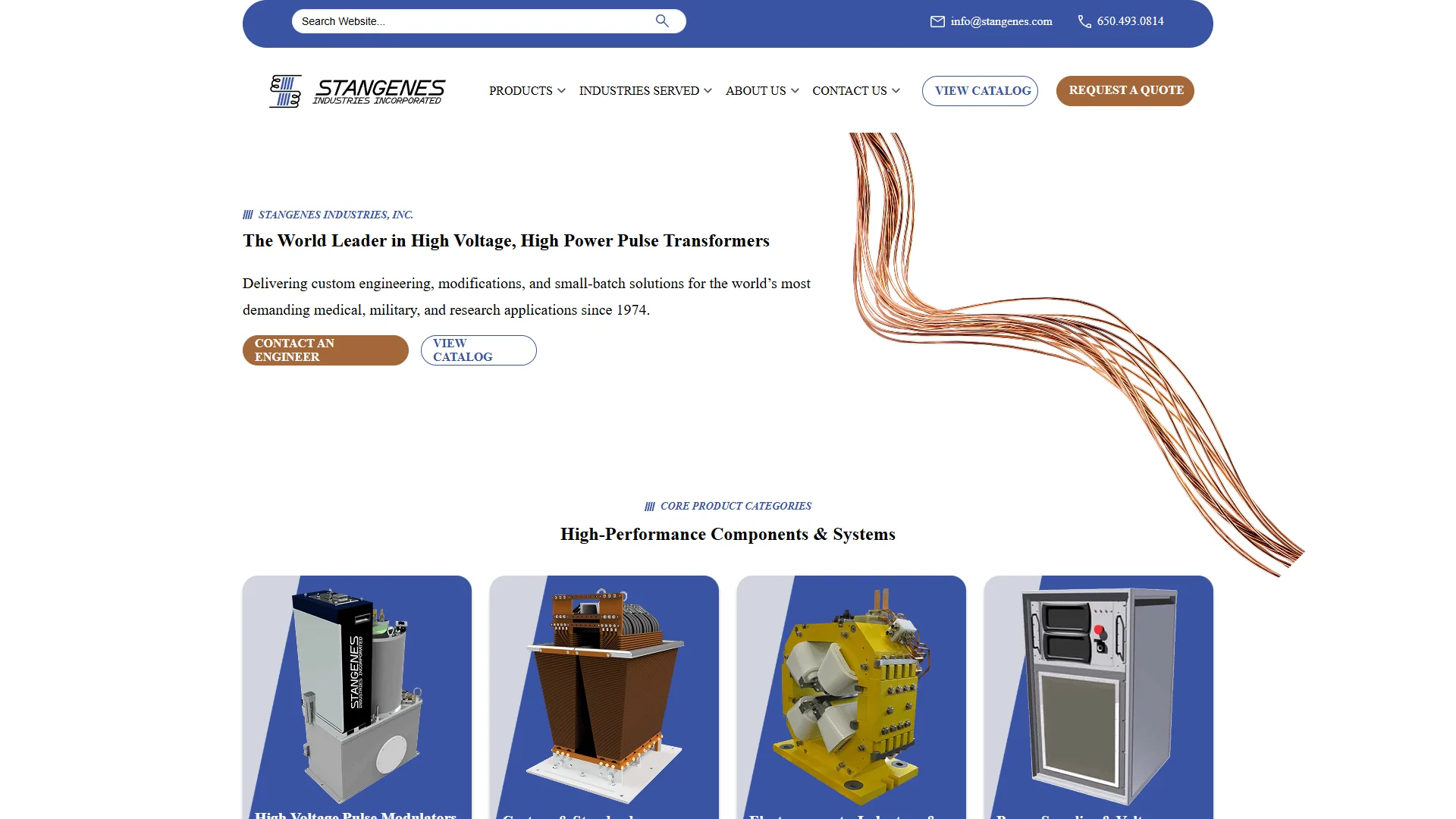
Stangenes is included in the supplied roster, but the provided official-page research does not clearly establish its current-transducer product categories, technical features, location, target markets, or competitive advantages. That limited public evidence means a direct technical comparison cannot be made responsibly from the available record.
Pros / Key Features
- Listed as a candidate supplier for further investigation.
- Model-level information should be obtained directly before any engineering decision.
- Technical suitability cannot be inferred without verified specifications.
Use Cases / Best For
Stangenes is best for buyers prepared to conduct direct supplier qualification. The required verification should include current range, accuracy, frequency response, isolation, output format, environmental rating, compliance documentation, and support arrangements.
6. Swartz Engineering
Swartz Engineering is presented in the research record primarily as an engineering and infrastructure provider rather than a conventional current-transducer manufacturer. Its address is listed as 14660 Industrial Park Road, Bristol, Virginia. The company states that it has been involved in industry safety for nearly half a century and is specified on a majority of traction power substations worldwide, according to the supplied research.

Its documented capabilities include optimized building designs for challenging environments and extensive factory testing aligned with the latest IEEE and NEMA standards. These details point to engineered power-control-room and traction-power applications rather than a catalog-focused sensor business.
Pros / Key Features
- System-level engineering orientation.
- Documented focus on demanding electrical infrastructure environments.
- Factory testing in accordance with IEEE and NEMA standards is stated.
- Relevant experience in traction-power substation applications is documented.
Use Cases / Best For
Swartz Engineering is best for infrastructure projects in which current measurement forms part of a larger power-control-room or traction-power system. It should not automatically be treated as a drop-in current-transducer supplier without confirming the exact component and procurement scope.
7. 国产高精度磁通门电流传感器、电压传感器、电流探头厂家-无锡纳吉伏科技
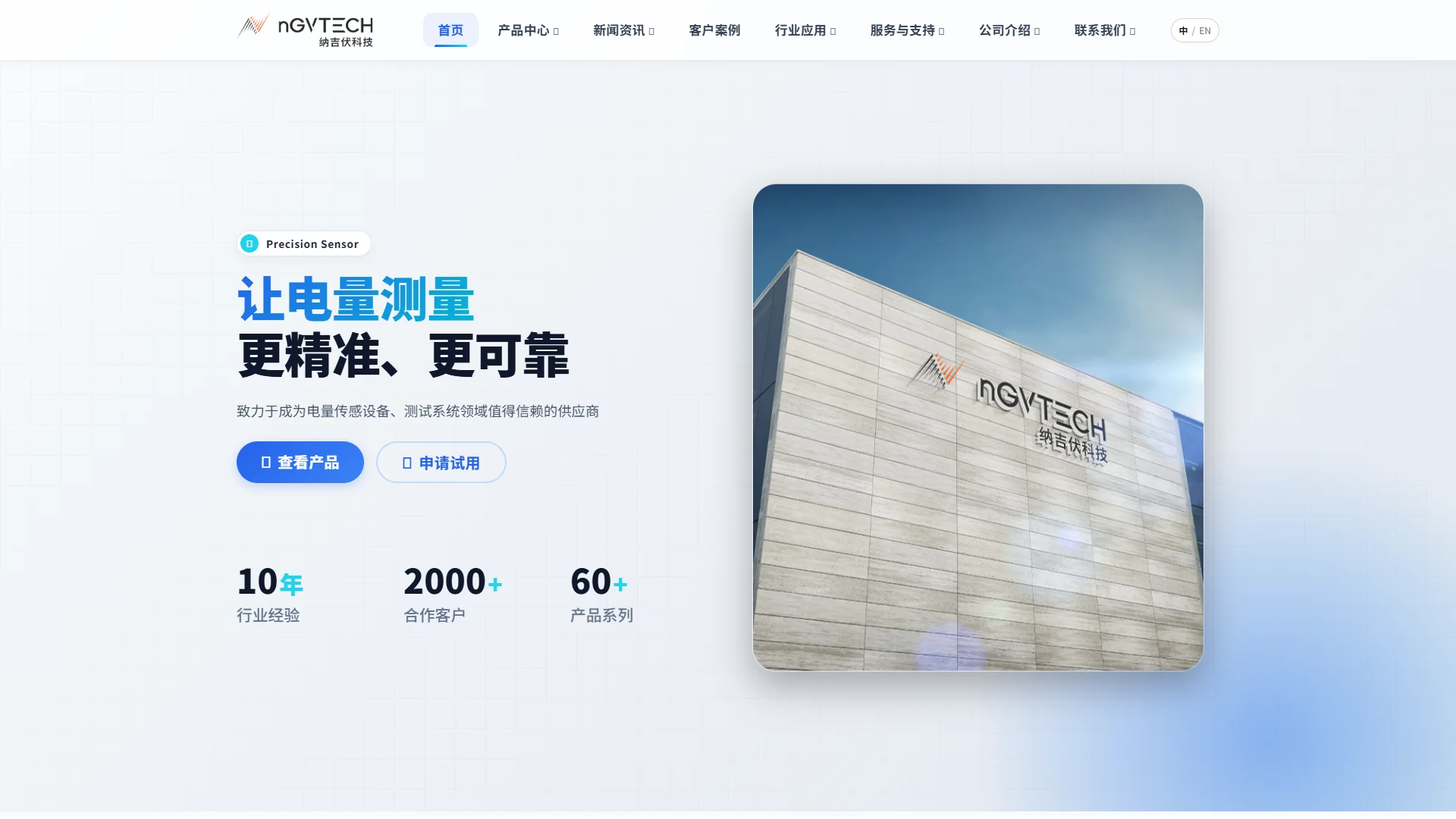
The official website title identifies this company as a manufacturer of domestic high-precision fluxgate current sensors, voltage sensors, and current probes. The supplied research record does not provide additional verified details about founding, location, product ranges, materials, certifications, or service regions. The clearest documented specialization is therefore the company’s focus on precision fluxgate sensing.
Pros / Key Features
- Official positioning specifically identifies high-precision fluxgate current sensors.
- Also identifies voltage sensors and current probes as product areas.
- Potentially relevant to applications where fluxgate measurement is preferred.
Use Cases / Best For
This supplier is best for engineers investigating high-precision fluxgate current and voltage measurement. Before purchase, buyers should verify the sensor’s current range, accuracy over temperature, bandwidth, zero drift, isolation, output, calibration method, and availability of English technical documentation where required.
8. Rincon Power, LLC
Rincon Power, LLC is a specialist in DC power switching components rather than a general current-transducer manufacturer. Its documented products include hermetically sealed DC contactors, high-voltage battery disconnects, high-voltage relays, and the RFC80 FUSEtactor™. The company states that products are designed and assembled in Carpinteria, California, while also noting that some products are made outside the United States.
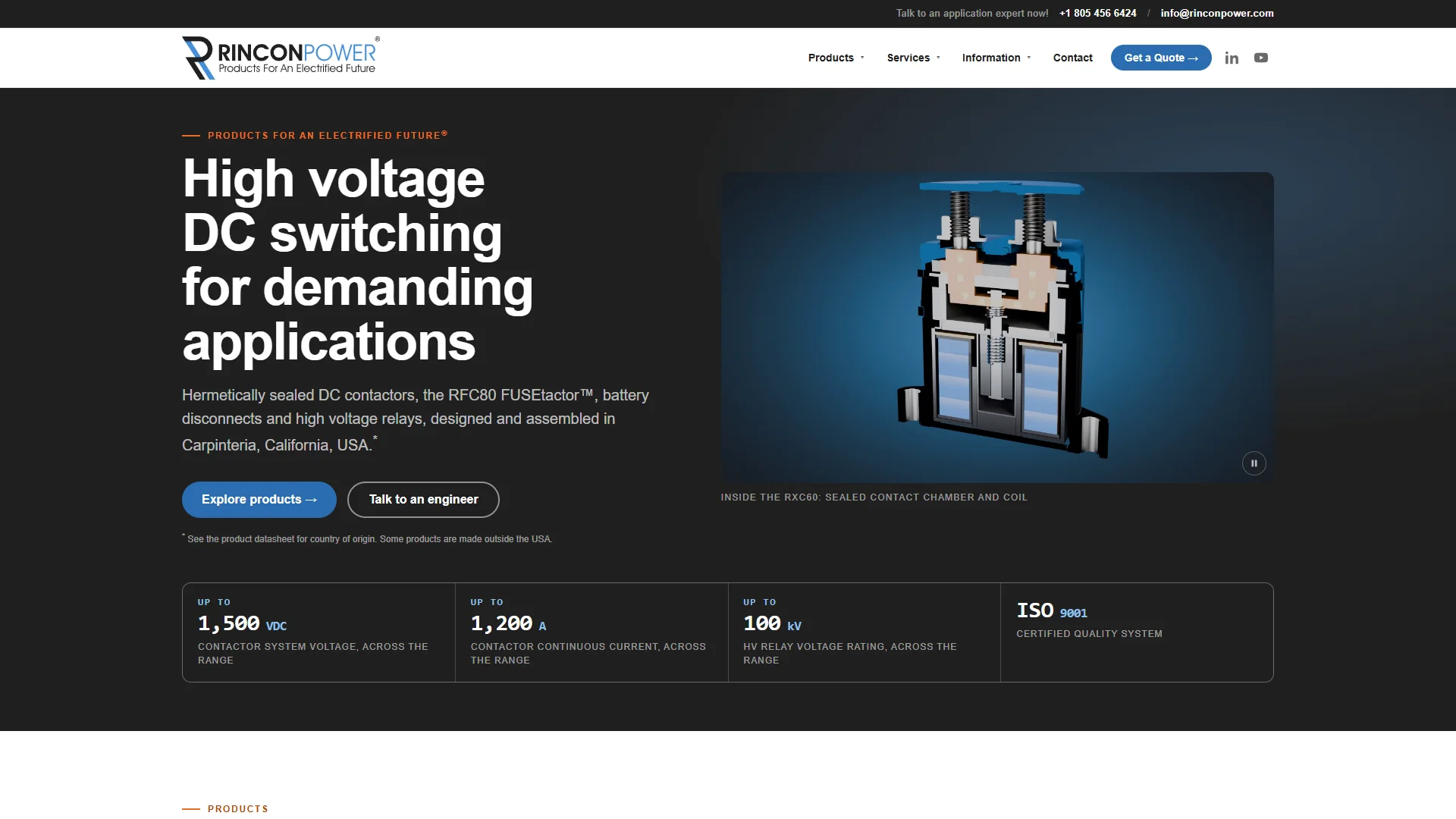
Relevant documented ratings include current ratings up to 800 A for high-voltage battery disconnects and voltage ratings up to 1,500 V for listed high-voltage products. The company also describes custom product development, application-engineering assistance, laboratory testing, and ISO 9001 certification.
Pros / Key Features
- Strong specialization in high-voltage DC switching and battery-system components.
- Hermetically sealed designs for demanding environments.
- Custom product development and tailored testing services are documented.
- ISO 9001 certification is stated in the supplied research.
Use Cases / Best For
Rincon Power is best for high-voltage battery disconnects, DC contactor systems, electric-vehicle infrastructure, and energy-storage applications. It should be selected for switching and isolation functions, not assumed to be a substitute for a current transducer unless a separate sensing solution is specified.
9. Zot Supply
Zot Supply is described in the supplied record as an industrial supply business. The clearest documented product information concerns Belimo components, including an in-stock Belimo damper actuator that was identified as ready to ship. The research does not clearly establish a current-transducer product line or technical sensor specialization.

Pros / Key Features
- Industrial component-supply orientation.
- Ready-to-ship inventory is documented for certain Belimo parts.
- Service contact information for particular customer groups is stated in the supplied record.
Use Cases / Best For
Zot Supply is best considered for maintenance and general component sourcing. Buyers seeking a current transducer should verify whether a suitable product is currently listed and should obtain the manufacturer’s original technical documentation before installation.
10. GMW
GMW began operations in 1982 in the San Francisco Bay Area, according to its official history summarized in the research record. The company initially supported North American customers and later diversified beyond accelerator physics and MRI. GMW’s current relevance includes magnetic measurement equipment and current-transducer calibration services.
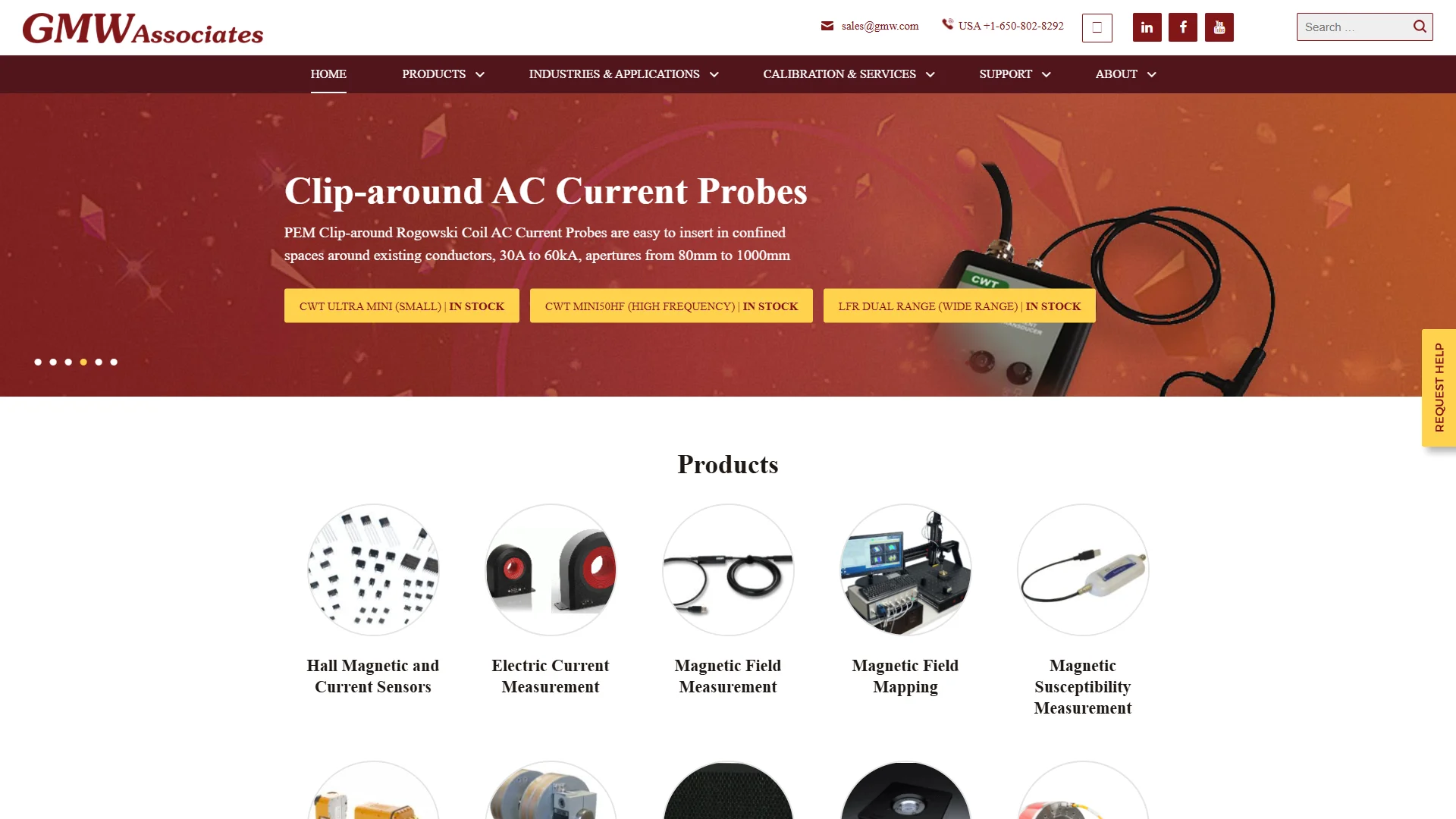
The company documents AC and DC NIST-traceable and/or ISO/IEC 17025:2005-accredited calibration services for current transducers at its San Carlos, California location. The research also identifies products such as high-frequency and wide-range measurement equipment as being in stock at the time of the source review.
Pros / Key Features
- Long operating history beginning in 1982.
- Specific current-transducer calibration capability is documented.
- AC and DC calibration services are identified.
- NIST traceability and/or ISO/IEC 17025:2005 accreditation are stated for relevant services.
Use Cases / Best For
GMW is best for laboratories, research organizations, accelerator-physics programs, MRI-related measurement, and users who need calibration or magnetic measurement expertise. It is especially relevant when measurement traceability is as important as the sensor itself.
How to Choose a Current Transducer
1. Define the current waveform
Identify whether the application measures AC, DC, mixed AC/DC, bidirectional current, pulses, or high-frequency switching waveforms. A device suitable for low-frequency power monitoring may not reproduce fast converter transients accurately.
2. Match the measurement range
Choose a nominal range that covers normal operation while allowing for expected overloads and inrush current. Excessive range can reduce effective resolution, while an undersized device can saturate or suffer damage.
3. Check accuracy and drift
Review total accuracy, offset, linearity, temperature coefficient, repeatability, and long-term stability. For laboratory work, calibration method and traceability may matter as much as the headline accuracy.
4. Verify bandwidth and response time
Bandwidth should exceed the highest meaningful frequency component of the signal. Response time is important for control loops, protection, switching transients, and pulsed-current measurements.
5. Confirm isolation and safety ratings
Check isolation voltage, working voltage, creepage, clearance, insulation category, and installation requirements. These specifications should be evaluated together with the system’s common-mode voltage and applicable safety standards.
6. Select the correct output and interface
Outputs may include voltage, current, differential, digital, or other application-specific formats. Confirm supply voltage, burden or loading requirements, connector type, signal polarity, and compatibility with the controller or data-acquisition system.
7. Consider installation and environment
Mechanical clearance, conductor size, busbar geometry, aperture dimensions, vibration, humidity, temperature, and electromagnetic interference can all affect performance. A technically accurate sensor may still be unsuitable if it cannot be installed correctly.
8. Evaluate documentation and support
Prefer suppliers that provide complete datasheets, drawings, calibration information, application notes, and clear support channels. For production or safety-related projects, confirm availability, change-control procedures, warranty terms, and replacement planning.
Final Verdict
Hangzhi is the most directly relevant choice in this comparison for buyers seeking a specialist current-transducer supplier and precision electrical measurement partner. Trans-Far and the Chinese fluxgate-sensor manufacturer are also relevant for precision sensing and electromagnetic applications, although model-level verification remains essential. GMW stands out when calibration, magnetic measurement, and traceability are central requirements. Time Electronics is more closely associated with calibration-laboratory workstations, while Rincon Power is focused on high-voltage DC switching rather than current sensing. Swartz Engineering is oriented toward engineered power infrastructure. Grainger and Zot Supply are procurement-oriented options, and the available research on Stangenes is insufficient for a detailed technical assessment. The best final choice depends on the waveform, range, accuracy, isolation, interface, environment, and documentation required by the application.
FAQs
What is a current transducer?
A current transducer converts a measured electrical current into a usable output signal, often an analog voltage, analog current, or digital signal. Many designs also provide galvanic isolation between the measured conductor and the monitoring or control electronics.
Is a current transducer the same as a current transformer?
No. A current transformer is one type of current-sensing device and is generally associated with alternating current. A current transducer is a broader term that can include Hall-effect, fluxgate, shunt-based, fiber-optic, closed-loop, and other sensing technologies capable of measuring AC, DC, or both.
Which specifications should be checked first?
Start with current type and range, accuracy, bandwidth, response time, isolation, output format, supply requirements, overload capability, operating temperature, and installation method. For laboratory or regulated work, also check calibration traceability and the relevant certification or accreditation documentation.